Blog
The Strongest Non-Magnetic Metals: Stainless Steel vs Titanium vs Beryllium Copper

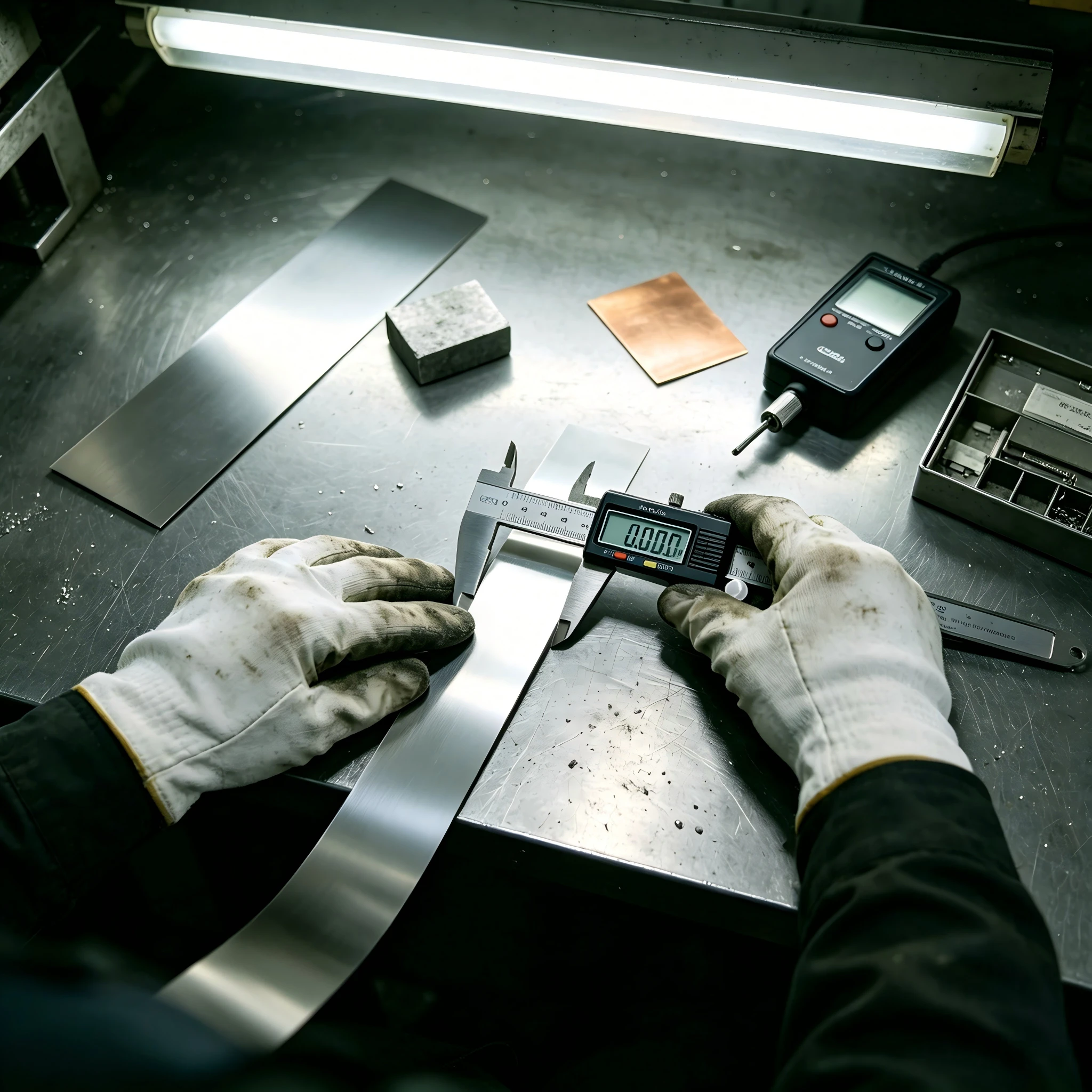
What is the strongest non-magnetic metal? The honest answer depends on how you define “strong” — tensile strength, yield strength, magnetic stability, or strength per dollar. Across engineering, four material families dominate the answer: cold-worked austenitic stainless steel, high-nitrogen stainless steel, titanium alloys and beryllium copper. Each one wins a different category. This guide compares them head to head — by strength, by relative permeability, by cost and by formability — so you can pick the right one for springs, fasteners, MRI components, sensors and structural parts without over-specifying.
What “Strongest” Means for a Non-Magnetic Metal
Before comparing materials, three definitions matter. Yield strength is the stress at which a material permanently deforms — the number most engineers design to. Tensile strength is the peak stress before fracture, which matters for fasteners and safety parts. Fatigue strength is the stress a material survives over millions of cycles, which decides spring and component life. A “strongest” metal for one application is often the wrong choice for another.
For non-magnetic applications there is a fourth metric that is easy to overlook: permeability stability. A material that starts non-magnetic can become magnetic after forming. Cold work transforms austenite into strain-induced martensite, and some precipitation-hardening treatments do the same. The truly strongest non-magnetic metal is not the one with the highest peak strength — it is the one that holds both strength and non-magnetic behaviour through your manufacturing process. For the fundamentals of permeability and crystal structure, see our non-magnetic stainless steel definitive guide.
The Four Candidate Families: Head-to-Head
These four families represent every practical answer to “strongest non-magnetic metal”. The table below compares them on the metrics that decide real projects.
| Material | Family | Yield strength (typical) | Relative permeability μr | Relative cost | Best role |
|---|---|---|---|---|---|
| 316L cold-worked | Austenitic stainless | 800–1,400 MPa (full hard) | 1.01–1.05 | $ (baseline) | Springs, stampings, fasteners, structural parts |
| 17-7PH (Condition A) | Semi-austenitic PH stainless | ~1,500–1,650 MPa (CH900) | Annealed ~low; rises after ageing | $$ | High-temp springs, aerospace (verify magnetic state) |
| Nitronic 50 / 60 | High-nitrogen austenitic | 700–1,200 MPa (cold drawn) | ~1.003 | $$$ | Shafting, fasteners, marine, nuclear |
| Ti-6Al-4V | Titanium alloy | ~950–1,100 MPa | ~1.00005 | $$$$ | Aerospace, medical implants, extreme environments |
| C17200 beryllium copper | Copper alloy (non-ferrous) | ~1,200–1,400 MPa (aged) | ~1.0000 (non-ferrous) | $$$$$ | Connectors, springs, tools where spark resistance matters |
| 40Mn18Cr3 / Mn13 | High-manganese steel | ~200–350 MPa (low) | ~1.01–1.05 (austenitic) | $ | Transformer tanks, magnet frames, wear liners |
The short answer: if “strongest” means best balance of strength, non-magnetic stability and cost, the winner is cold-worked 316L stainless steel. If it means absolute strength with certified low permeability regardless of cost, the winners are titanium (Ti-6Al-4V) and high-nitrogen Nitronic 50. If it means non-ferrous and spark-safe, the winner is beryllium copper.
High-Strength Non-Magnetic Stainless Steel: The Practical Winner
Austenitic stainless steel is the only family that combines non-magnetic behaviour, high strength after cold work, excellent corrosion resistance and industrial pricing. Within it, three sub-groups matter.
316L in Hard Tempers
Cold rolling 316L to full-hard increases yield strength from roughly 300 MPa to 800–1,400 MPa depending on reduction, while keeping relative permeability in the 1.01–1.05 range. This is why hard-tempered 316L strip is the default for non-magnetic springs, constant-force springs, clips and precision stampings. It is the strongest non-magnetic metal for the money — typically a fraction of the cost of titanium or Nitronic. The trade-off is formability: full-hard material stamps cleanly but does not deep-draw. For the grade-by-grade breakdown of the austenitic family, see our non magnetic stainless steel grades compared guide.
17-7PH: Extremely Strong, But Check the Magnetic State
17-7PH is a semi-austenitic precipitation-hardening alloy that reaches tensile strengths around 1,650 MPa in the CH900 condition — among the highest of any stainless. The caveat is critical for non-magnetic applications: the precipitation-hardening heat treatment that creates that strength transforms the structure toward martensite, which raises magnetic permeability. In the annealed (Condition A) state 17-7PH is weakly magnetic; after CH900 ageing it becomes noticeably magnetic. If you need both ultra-high strength and guaranteed low permeability, verify the actual μr of the heat-treated part rather than assuming from the grade name. For the spring-specific comparison of 301 and 17-7PH — tempers, strength and operating temperature — see our 301 vs 17-7PH spring steel guide.
Nitronic 50 and 60: Strength Plus Certified Low Permeability
High-nitrogen austenitic grades such as Nitronic 50 (UNS S20910) and Nitronic 60 deliver the best of both worlds: nitrogen strengthening gives yield strengths of 700–1,200 MPa in cold-drawn forms, while the fully austenitic structure holds relative permeability around 1.003 — more stable than 304 or 316 under cold work. Nitronic 50 also offers superior corrosion resistance and is specified in marine shafts, nuclear components and high-strength fasteners where magnetic stability under service is non-negotiable. It costs more than 316L but far less than titanium. We supply Nitronic 50 in precision ground round bar and cold-drawn forms — see the non-magnetic stainless steel price and grade selection guide for reference pricing and sourcing notes.
Titanium and Beryllium Copper: The Non-Ferrous Extreme
When the application demands a non-ferrous material — zero magnetic response, immunity to magnetization — the strongest candidates are titanium and beryllium copper.
Titanium (Ti-6Al-4V) is the strongest non-magnetic metal in the conventional sense: yield strength around 950–1,100 MPa, density 60% of steel, outstanding corrosion resistance, and relative permeability essentially equal to vacuum (~1.00005). It is the standard for aerospace fasteners, medical implants and cryogenic components where both strength and absolute non-magnetic behaviour are required. The cost — typically 10–50 times 316L per kilogram — confines it to applications where nothing else works.
Beryllium copper (C17200) is the strongest non-ferrous alloy family. In the aged condition it reaches 1,200–1,400 MPa tensile strength — comparable to high-strength steels — while remaining fully non-magnetic and non-sparking. It is the material of choice for precision connectors, spring contacts, tooling in explosive atmospheres and instrument components. Its limitations are cost, limited formability at high hardness, and the need for controlled heat treatment. For transformer and motor components where copper alloys are the design starting point, our copper strip buying guide covers the wider copper family.
High-Manganese Non-Magnetic Steel: The Industrial-Strength Option
Outside stainless steel, a less-known family deserves mention: high-manganese austenitic steels such as 40Mn18Cr3, 20Mn23Al and Hadfield Mn13. These nickel-free steels are non-magnetic, cheap, and widely used for transformer tanks, magnet frames, electrical machine end bells and wear liners. Their weakness is strength — yield strength is typically 200–350 MPa, far below the stainless options — so they suit structural and shielding parts rather than springs or fasteners. If your enquiry is for “non-magnetic steel” rather than stainless, this is the family your supplier is likely quoting.
How to Choose by Application
| Application | Recommended material | Why |
|---|---|---|
| Non-magnetic springs & constant-force springs | Cold-worked 316L / 301 | Best strength-cost balance; full-hard tempers |
| MRI components & imaging fixtures | 316L, 310S, Nitronic 50 | Certified μr < 1.01–1.005; no magnetic drift |
| Aerospace fasteners & high-load parts | Ti-6Al-4V, Nitronic 50 | Strength + absolute non-magnetic behaviour |
| Sensor housings & instrument parts | 316L / 304L annealed | Low permeability + formability + cost |
| Explosive-atmosphere tools & connectors | Beryllium copper | Non-sparking, non-magnetic, high strength |
| Transformer tanks & magnet frames | 40Mn18Cr3 / Mn13 | Cheap, non-magnetic, weldable structural steel |
Why Permeability Stability Matters More Than Peak Strength
The most expensive mistake in this space is specifying a material that tests non-magnetic on receipt and magnetises during production. 304 and 316 can both transform partially to magnetic martensite under heavy stamping, slitting or drawing — 304 far more readily than 316. A “strongest” material that drifts from μr 1.01 to μr 1.5 in your forming line fails the specification at the worst possible moment. If your application has a permeability limit, write it into the drawing (μr < 1.01, or μr < 1.005 for medical and MRI) and verify it on the finished part, not just the raw coil. Our guide to magnet testing and permeability verification explains both the shop-floor magnet check and the calibrated ASTM A342 measurement.
Sourcing High-Strength Non-Magnetic Materials: What to Specify
When you source non-magnetic material for strength-critical parts, put these five points in writing:
- Material + temper/condition — 316L full-hard vs annealed; Nitronic 50 cold-drawn; Ti-6Al-4V annealed vs solution-treated; C17200 aged. The condition is half the specification.
- Permeability limit — μr < 1.01 standard, μr < 1.005 where the application demands it, verified to ASTM A342.
- Mechanical properties — yield, tensile and hardness targets, confirmed on the Mill Test Certificate rather than assumed from the grade.
- Thickness tolerance and edge — for precision stamping and slitting, ±0.01 mm tolerances with deburred or rounded edges protect tooling and part consistency.
- Mill Test Certificate with heat number — traceable chemistry, mechanicals and permeability, coil by coil. If you need a refresher on what a 3.1 certificate must contain, see our MTC / EN 10204 3.1 explainer.
Fullgreat Metal — the Shenzhen branch of Hong Kong FGI Group — supplies non-magnetic stainless steel strip in 0.05–2.0 mm (SUS 304/316L) in 2B, BA and 8K finishes, plus high-nitrogen grades and non-magnetic wire (FPD901/902), with a monthly capacity of 50,000 tons, 10,000 tons of inventory and partnerships with 100+ mills in Japan, Korea, Germany, Taiwan and China. Since 2008 we have served more than 1,000 enterprises across 20+ countries under ISO 9001:2015, GRS and OEKO-TEX STANDARD 100 certification. Standard supply is μr < 1.01; μr < 1.005 is available on request, with heat-numbered Mill Test Certificates on every shipment. For application guidance in precision instruments, see our non-magnetic stainless steel for sensors and instruments guide.
Frequently Asked Questions
Q: What is the strongest non-magnetic metal?
A: By strength-per-cost, cold-worked 316L stainless steel. By absolute strength with certified low permeability, titanium (Ti-6Al-4V) and high-nitrogen Nitronic 50. By non-ferrous strength, beryllium copper (C17200). The right answer depends on whether your constraint is budget, permeability or environment.
Q: Is 17-7PH stainless steel non-magnetic?
A: In the annealed Condition A it is weakly magnetic; after the CH900 precipitation-hardening treatment it becomes noticeably magnetic as the structure transforms toward martensite. Do not assume 17-7PH is non-magnetic in its strongest condition — verify the actual μr if the application demands it.
Q: What is stronger, titanium or stainless steel?
A: Titanium alloys like Ti-6Al-4V reach higher yield strengths than annealed stainless (950–1,100 MPa vs 200–300 MPa), but cold-worked 316L in full-hard tempers reaches 800–1,400 MPa at a fraction of titanium’s cost. For strength-per-dollar, hard-tempered stainless wins.
Q: Is beryllium copper non-magnetic?
A: Yes. Beryllium copper is a non-ferrous alloy with essentially zero magnetic response, and it reaches tensile strengths of 1,200–1,400 MPa in the aged condition — the strongest non-ferrous non-magnetic option for connectors and springs.
Q: Which non-magnetic metal is best for springs?
A> For most industrial springs, cold-worked 316L or 301 stainless offers the best combination of strength, fatigue life, non-magnetic behaviour and cost. For high-temperature or ultra-high-strength springs, 17-7PH works — but verify the magnetic state of the final heat treatment. For spark-safe or corrosive environments, beryllium copper is the specialist choice.
Q: Does cold working make non-magnetic stainless magnetic?
A> Yes. Heavy stamping, drawing or slitting transforms austenite into strain-induced martensite, raising permeability. Higher-nickel grades (316, 310S, 904L, Nitronic 50) resist this far better than 304. Specify a permeability limit and verify on the finished part if it matters.
Need high-strength non-magnetic material — strip, wire or bar — with certified permeability? Send your grade, dimensions, strength target and maximum μr to Bruce@fullgreat.com and we will confirm availability, temper and heat-numbered MTC documentation before you commit.