Blog
Solving Cold-Work Embrittlement in Stainless Steel Strips

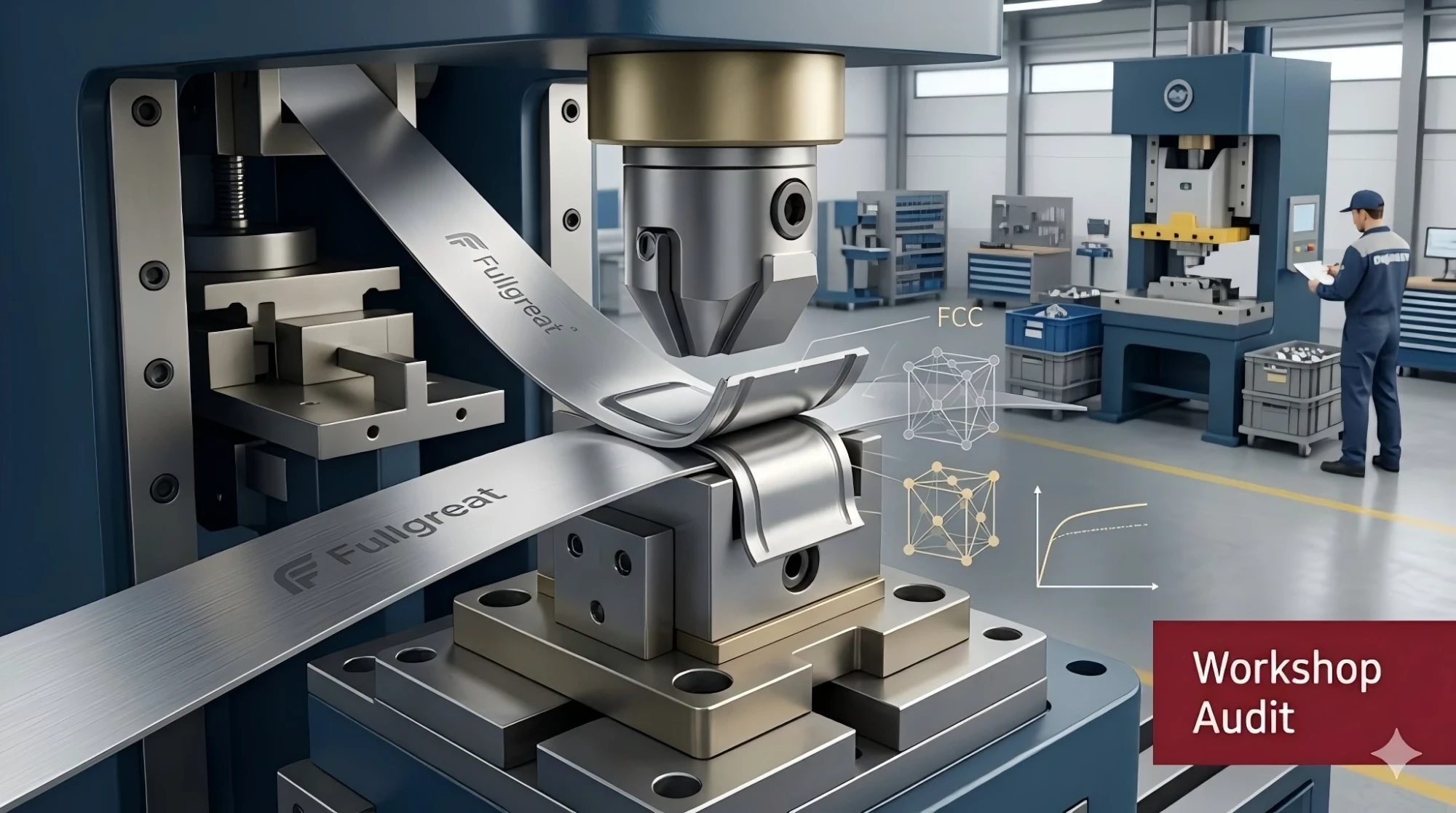
In high-speed stamping lines, discovering micro-fractures on formed components is a persistent nightmare. While operators often blame die clearance or press speed, the root cause is almost always material-driven. When facing stainless steel strip cold-work embrittlement, the core issue is the rapid saturation of internal lattice stress. This guide breaks down the physical mechanics behind forming failures and how Fullgreat mitigates them at the metallurgical level to protect your yields.
For the fundamentals of austenitic grades and their behavior under cold work, see our Non-Magnetic Stainless Steel: The Definitive Guide.
Failure Analysis: How Forming Destroys Ductility
When a stainless steel coil undergoes deep drawing or sharp bending, it experiences rapid work hardening. Our failure analysis laboratory has identified two primary mechanisms that turn a ductile strip into a brittle liability:
- Dislocation Stacking Failures: As plastic deformation exceeds critical thresholds, internal dislocations become tangled and immobile. This concentrates immense stress at the grain boundaries, dropping localized elongation near zero and initiating cracks.
- Strain-Induced Martensite (SIM): In specific austenitic grades (like 304), heavy cold-working triggers a phase shift. Metastable austenite transforms into hard, brittle martensite, creating internal structural discontinuities that tear under subsequent forming pressure. This is the same phase change that makes worked stainless develop a magnetic pull — see our magnet test and permeability guide.
The Hidden Cost of Embrittlement on the Shop Floor
Procuring “cheaper” stainless steel strips often results in catastrophic hidden costs downstream. The financial impact of cold-work embrittlement extends far beyond the price of the raw coil:
- Massive Scrap Rates: Parts that crack during the final bending stage mean wasted material, wasted energy, and wasted machine time.
- Manual Sorting Costs: If cracks are microscopic, QA teams must employ expensive sorting procedures (e.g., eddy current testing or visual inspection) to prevent defective parts from reaching your customers.
- Catastrophic Die Damage: Hard, embrittled material causes excessive wear on forming dies, accelerating tooling depreciation and forcing unexpected downtime.
Investing in engineered, stress-relieved coils eliminates these bottlenecks, drastically improving overall equipment effectiveness (OEE).
Strategic Countermeasures: The Fullgreat Protocol
To eliminate embrittlement risks in complex structural components, we implement strict metallurgical controls before the coil ever reaches your facility:
1. Gradient Annealing Control: Unlike conventional batch annealing, our multi-stage temperature ramp ensures maximum grain orientation consistency. This effectively flattens the work-hardening curve, allowing for deeper draws without fracturing.
2. Tailored Nickel Equivalency: For extreme forming applications, we optimize the alloy chemistry by adjusting the Nickel equivalents, inherently stabilizing the austenitic matrix and resisting the transition to brittle martensite. Higher-stability grades like 316L are also available — see our 304 vs 316 comparison.
On-Site Diagnostic Checklist: Evaluate Your Current Coil
Are you dealing with stainless steel strip cold-work embrittlement right now? Have your engineering team run these three quick checks on your current material:
- The Tight Radius Bend Test: Perform a 180-degree bend over a tight radius (e.g., 1T or zero-T depending on gauge). Check the outer apex under a magnifier. Any “orange peel” effect or micro-fissures indicates insufficient ductility.
- Slit Edge Burr Inspection: Examine the edges of the strip. Excessive burrs or hardened edges from the slitting process will act as stress concentrators, initiating edge-cracking during stamping. For sourcing guidance, see our Stainless Steel Strip Supplier Guide.
- Magnetic Response Check: Test the cracked area of your stamped part with a strong magnet. A significant increase in magnetism compared to the unformed flat strip confirms excessive strain-induced martensite formation.
Field Validation: Stamping Yield Data
| Forming Metric | Standard Market Strip | Fullgreat Optimized Strip |
|---|---|---|
| Cracking Rate (Complex 90° Bends) | 4.2% – 6.5% | < 0.5% |
| Residual Tensile Stress | High Variability | Stabilized Mean |
Optimized annealing and chemistry keep austenite stable, cutting cracking rates from 4.2–6.5% down to below 0.5%. This same stability preserves non-magnetic properties after forming, which matters for electronics and medical housings. For strict low-permeability requirements, review our non-magnetic stainless steel inventory.
Frequently Asked Questions
Q: Why does my stainless steel strip crack when I bend or stamp it?
A: The usual culprit is cold-work embrittlement. Heavy forming drives rapid work hardening: dislocations become tangled and immobile, concentrating stress at grain boundaries, while metastable austenite (in grades like 304) transforms into hard, brittle strain-induced martensite. Both mechanisms drop ductility near zero and initiate cracks. Using stress-relieved, gradient-annealed strip prevents this.
Q: What is strain-induced martensite and why does it make stainless steel magnetic?
A: Strain-induced martensite (SIM) is a phase that forms when metastable austenite is heavily cold-worked (bending, stamping, deep drawing). It is hard, brittle, and magnetic. This is why a stamped 304 part may show a magnetic pull at worked edges even though the annealed strip was non-magnetic. Higher-nickel grades like 316L resist SIM formation much better.
Q: How can I test if my stainless steel strip will crack during forming?
A: Run the three-part diagnostic: (1) a tight-radius 180° bend test checking for orange-peel or micro-fissures, (2) a slit-edge burr inspection for stress concentrators, and (3) a magnetic response check — a strong magnetic pull in the worked area indicates excessive SIM formation. Together these flag embrittlement before it reaches your production line.
Q: How do I prevent stainless steel strip embrittlement in my supply chain?
A: Source from a supplier that applies gradient annealing and tailored nickel-equivalent chemistry, which flatten the work-hardening curve and stabilize the austenitic matrix. Specify stress-relieved coils and, for extreme forming, choose higher-stability grades like 316L. This cuts cracking rates from 4-6% to below 0.5% and preserves non-magnetic properties after forming.
Is your material forming yield below 98%? Share your part drawings and current scrap rates with us at Bruce@fullgreat.com. Our metallurgical team will provide a Metal Strip Formability Optimization Report tailored to your specific shop-floor constraints.