Blog
Non-Magnetic Stainless Steel for Sensors & Instruments

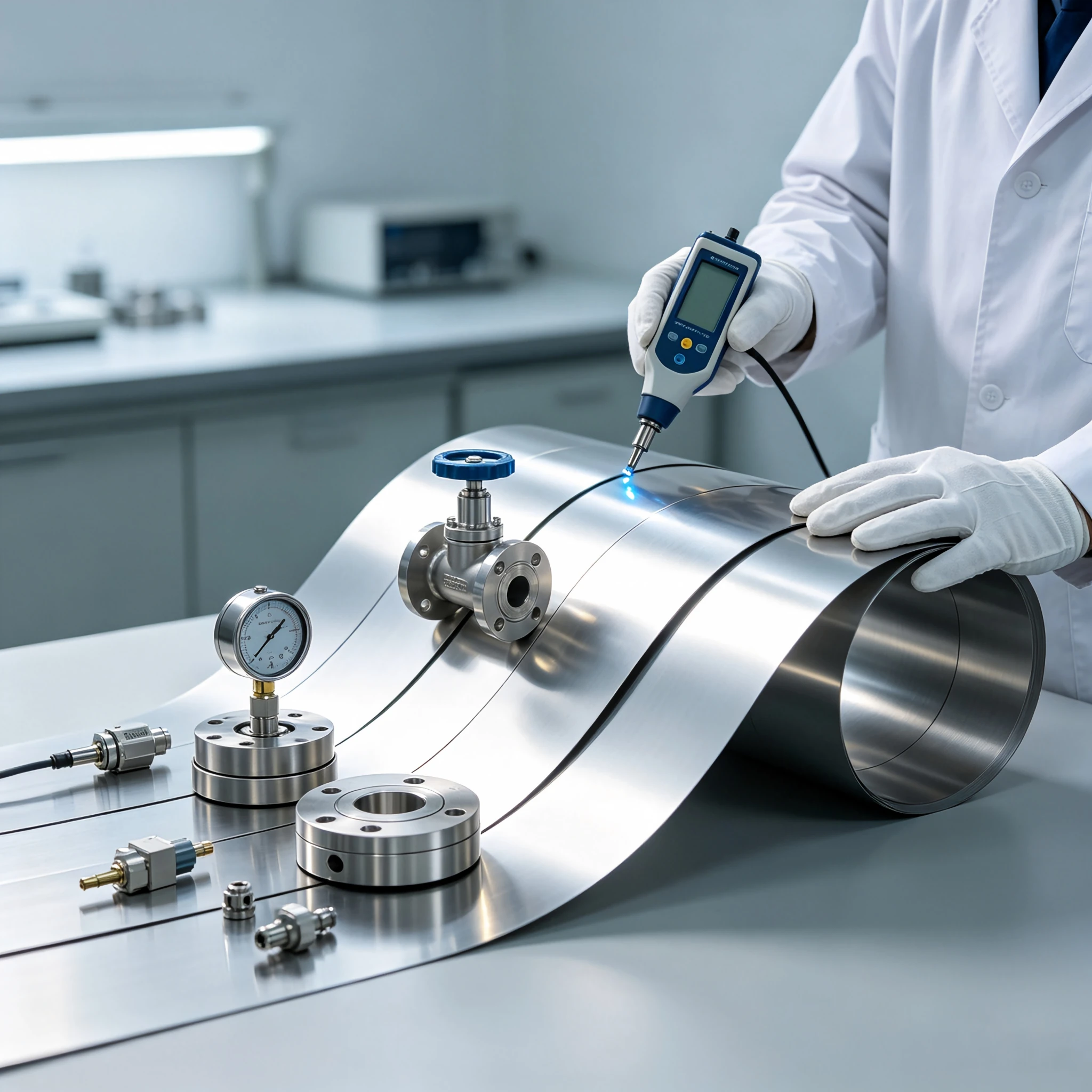
For sensors and instruments, non-magnetic stainless steel is not a nice-to-have spec — it is the difference between a measurement and a guess. A flow meter that drifts 0.3% because its wetted parts pull to the earth’s field. An MRI suite where a stainless bracket distorts image uniformity. A lab balance that never zeroes because a ferromagnetic housing is stealing flux from the load cell.
This guide is written for engineers and procurement teams who need non-magnetic stainless steel for sensors, transducers, MRI and laboratory instruments — and who want the grade, the permeability target, and the supplier verification locked down before they commit. If you need the fundamentals first, start with our Non-Magnetic Stainless Steel: The Definitive Guide.
Why Magnetic Response Ruins Precision Measurements
Three failure modes dominate when magnetic stainless steel ends up inside a precision device:
- Sensor offset and drift. Hall-effect, magnetoresistive and inductive sensors are sensitive to any local change in magnetic field. A ferromagnetic structural part near the sensing element shifts the operating point and adds non-linearity.
- Eddy-current interference. Inductive and eddy-current-based measurement (proximity sensors, crack detection) is distorted by magnetic hysteresis and eddy losses in ferromagnetic housings and shields.
- MRI and field-critical environments. Near strong magnets and imaging systems, any ferromagnetic component distorts field homogeneity. This is why MRI rooms are specified with non-magnetic materials throughout — including the stainless steel in fixtures, housings and instrumentation.
For the practical side of testing — including the difference between a pocket-magnet check and a proper permeability measurement — see our guide to magnet testing and permeability measurement.
Key Applications and Material Requirements
| Application | Magnetic requirement | Typical grade & format |
|---|---|---|
| Flow meters & transducers | Low relative permeability (μr ≤ 1.01) for stable readings | SUS316L strip 0.3–1.2 mm, 2B surface |
| MRI room fixtures & enclosures | Non-magnetic + non-corrosive + cleanable | SUS316L, BA finish, tight flatness |
| Lab balances & precision scales | No magnetic flux stealing from load cells | SUS304L / 316L thin strip |
| Proximity & inductive sensors | No eddy/hysteresis distortion of sensing field | Non-magnetic strip, specified temper |
| Instrument housings & brackets | Consistent non-magnetic response across batch | SUS316L strip, batch permeability verified |
| Medical / diagnostic instruments | Skin-safe + MRI-compatible | SUS316L ultra-thin strip |
Where an instrument part also needs a copper or brass surface — decorative housings, connectors, conductive parts — copper clad non-magnetic stainless steel (FPD726) provides the same verified non-magnetic core with a copper finish.
For a grade-by-grade comparison — including which of 304, 316, 310, 321 and 904L hold their non-magnetic condition under cold working — see our grades comparison guide.
The Spec That Matters Most: Relative Permeability (μr)
In precision applications you specify relative permeability (μr), not a vague “non-magnetic” label. Annealed austenitic grades such as 304L and 316L typically sit at μr ≈ 1.003–1.01, which is effectively non-magnetic. By contrast, ferritic and martensitic grades (430, 420, 410) have μr well above 1 and are unsuitable.
Two things to watch:
- μr changes with cold working. Rolling, stamping, bending and drawing convert austenite to martensite and can push μr up — a part that is non-magnetic as a coil may not be after forming. The mechanism is explained in our article on why austenitic stainless steel becomes magnetic.
- Specify the finished part, not the raw material. Your procurement document should state a permeability target (e.g. μr ≤ 1.01) on the final machined or formed component, and your supplier should verify it accordingly.
Grade Selection for Sensor & Instrument Parts
For most instrument applications the choice narrows to austenitic grades with a deliberately low and stable permeability:
- SUS304L — the workhorse for internal brackets, housings and non-corrosive applications; low carbon reduces sensitisation and keeps properties consistent.
- SUS316L — preferred where corrosion resistance, skin contact and MRI compatibility matter (medical and diagnostic instruments); the most common choice for precision instrument strip.
- Stabilised / high-purity options — where very tight permeability control is needed, specify heat-lot selection and batch permeability verification.
Cold-worked tempers trade strength against magnetic response: a spring temper that hardens the strip also raises permeability. If your part needs both high strength and low μr, the grade and temper must be chosen together — and verified on the finished part.
Precision Strip Specs for Instruments
Instrument-grade parts usually need thin, clean, dimensionally stable strip. What we supply and what to ask for:
- Ultra-thin strip down to 0.05 mm for fine components (0.05–0.8 mm covers most sensor and instrument parts).
- Surface finishes: 2B for hidden parts, BA up to 8K mirror for visible or clean-room-friendly surfaces.
- Flatness and edge quality: specify deburred or rounded edges to keep stamping and feeding stable on high-speed lines.
- Tolerance: precision cross-section tolerance can be held to ±0.01 mm depending on specification.
Full specification and mechanical property data for our non-magnetic stainless steel strip are on the non-magnetic stainless steel strip product page. For the related precision-strip story in medical devices — where MRI compatibility is a certification issue — see our medical devices guide.
How to Verify What You’re Buying
Hand your supplier this verification list and you will separate a factory that controls permeability from a trader that just re-labels coils:
- Ask for the μr target in writing — and confirm it applies to the finished part, not the incoming coil.
- Demand a Mill Test Certificate with traceable heat numbers and exact composition. Learn what to check in our MTC / EN 10204 3.1 explainer.
- Request batch permeability verification — for instrument work, a certificate or report per batch (not a one-off sample) is what protects your production line.
- Check ultra-thin capability — clean, defect-free slitting at 0.05–0.3 mm is where most suppliers fail.
- Test a sample of the finished part with a permeability meter before scaling the order.
Who We Are and What We Can Verify
Fullgreat Metal is the Shenzhen branch of Hong Kong FGI Group, one of South China’s largest metal processing, sales and logistics centres. Since 2008 we have served more than 1,000 enterprises across China and exported to 20+ countries including the US, UK, India and Turkey.
For sensor and instrument applications we supply SUS304L and SUS316L ultra-thin strip from 0.05 mm up, with ISO 9001:2015, GRS and OEKO-TEX STANDARD 100 certifications, a monthly capacity of 50,000 tons, an inventory of 10,000 tons, and partnerships with 100+ steel mills in Japan, Korea, Germany, Taiwan and China. Every shipment carries a traceable Mill Test Certificate, so you can verify the heat — and the permeability — before your parts ever reach the production line.
Frequently Asked Questions
Q: What permeability should I specify for non-magnetic stainless steel in instruments?
A: For precision instruments, specify relative permeability μr ≤ 1.01 on the finished part. Annealed 304L/316L normally deliver μr ≈ 1.003–1.01. Above 1.02, most sensor applications start to see measurable error.
Q: Can I use 430 stainless steel in sensors?
A> No for precision magnetic applications. 430 is ferritic and strongly magnetic (μr well above 1), so it will interfere with sensors. Use an austenitic grade such as 304L or 316L instead.
Q: Why did my stamped instrument part become magnetic?
A: Cold working (stamping, bending, drawing) transforms some austenite to martensite, which is magnetic. Specify the final forming condition together with the grade, or request permeability verification on the finished part. See our austenitic magnetism guide.
Q: Is non-magnetic stainless steel for consumer electronics the same material?
A: The grades and strip are the same family, but instrument applications typically demand tighter permeability targets and batch verification. This guide and our consumer electronics article cover the two ends of that requirement.
Need non-magnetic stainless steel strip for a sensor or instrument program? Send your drawing and your μr target to Bruce@fullgreat.com — we will confirm grade, thickness, surface and batch permeability verification with MTC documentation before you commit.