Blog
Non-Magnetic Stainless Steel for Consumer Electronics

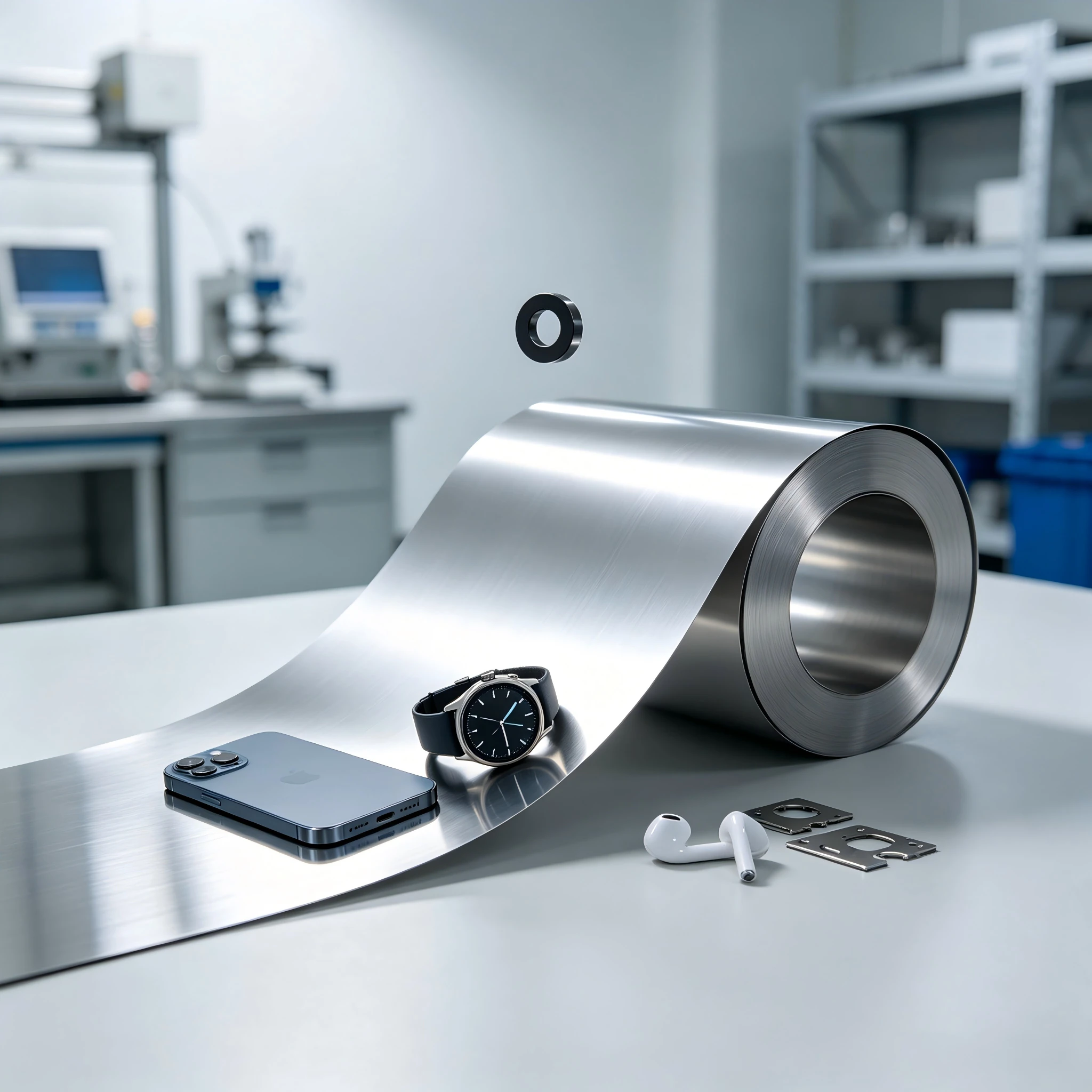
Picture this: you ship 50,000 units of a smartwatch only to find the heart-rate sensor drifts because a magnetic stainless steel case back is interfering with the magnetometer. Or a hearing-aid manufacturer rejects an entire connector batch because the housing pulls to a magnet on the assembly bench. In consumer electronics, magnetic response in stainless steel is not a cosmetic detail — it is a functional specification.
This guide answers one practical question: how do you source non-magnetic stainless steel for consumer electronics without guessing? We walk through why magnetism breaks devices, which applications need it most, the exact grades and specs to specify, and a decision checklist you can hand to your supplier. We also show what a factory that actually supplies this material — Fullgreat Metal’s Shenzhen operations — can verify for you.
If you need the fundamentals first, start with our Non-Magnetic Stainless Steel: The Definitive Guide.
Why Magnetic Response Breaks Consumer Electronics
Three mechanisms in a consumer device are vulnerable to magnetic interference from nearby metal parts:
- Magnetometers and compasses (phones, wearables, drones) measure the earth’s magnetic field in the microtesla range. A ferromagnetic housing just a few millimetres away can swamp the signal.
- Inductive charging and NFC rely on controlled magnetic flux. Eddy currents and magnetic hysteresis in a ferromagnetic shield waste energy and shift tuning.
- Audio components (speakers, earpieces) contain permanent magnets. If a nearby structural part is magnetic, it can steal flux, change field shape, and degrade sound or vibration output.
There is also a simpler, less technical reason: a magnet sticking to your product reads as “cheap” in quality inspection. Many consumer-electronics QC lines — and increasingly, end users — test parts with a simple magnet. For more on how that test works and its limits, see our guide to magnet testing and permeability measurement.
Where Non-Magnetic Stainless Steel Is Used in Consumer Electronics
Not every part needs it, but the list of parts that do is growing. The table below maps common applications to the material requirement and the grade we typically recommend.
| Application | Why non-magnetic matters | Typical grade & format |
|---|---|---|
| Smartphone & watch case backs, frames | Magnetometer accuracy; premium feel; corrosion resistance against skin contact | SUS316L strip 0.3–0.8 mm, BA or mirror finish |
| Hearing aids & earbuds | Tiny form factor; speaker magnet proximity; MRI compatibility (medical grade) | SUS316L strip 0.05–0.3 mm, ultra-thin |
| Connector shields, contacts | EMC shielding without magnetic hysteresis; consistent forming | SUS304 / SUS301 strip, spring temper |
| Inductive charging coils & NFC antennas | No magnetic flux loss; stable resonant frequency | Non-magnetic strip 0.1–0.5 mm, tight flatness |
| Wearable enclosures & decorative parts | Skin-safe corrosion resistance; non-magnetic for sensor arrays | SUS316L, 2B/BA surface |
| Buttons, logos & etched parts | Etching and marking quality; magnet-free in hand | Ultra-thin strip 0.05–0.2 mm, mirror 8K |
For a grade-by-grade comparison of 304, 316, 310, 321 and 904L — including which stay non-magnetic under cold working — see our grades comparison guide.
The Specs That Matter: Thickness, Surface and Tolerance
Consumer-electronics buyers usually reject strip for three reasons: it is too thick, the surface is not clean enough, or the tolerance is too loose. Here is what we produce and what to ask for:
- Ultra-thin strip: down to 0.05 mm (we supply 0.01–10 mm depending on grade). Hearing-aid and earbud parts are typically 0.05–0.3 mm.
- Surface finishes: 2B, BA, and up to 8K / 16K mirror, plus black, bronze and titanium-coloured options for visible decorative parts.
- Flatness and edge condition: specify deburred or rounded edges to avoid micro-tears in stamping and to keep feeding stable on high-speed lines.
- Tolerance: for precision strip, cross-section tolerance can be held to ±0.01 mm depending on the specification.
All of these are covered in our non-magnetic stainless steel strip specification sheet for buttons, zippers and electronics — including the full SUS304/316L mechanical property data.
An Important Trap: “Non-Magnetic” Is Not Permanent
Here is the mistake that costs consumer-electronics manufacturers the most: an annealed austenitic grade is non-magnetic, but cold working can make it magnetic again. Rolling, stamping, bending and drawing strain the microstructure and can transform some austenite to martensite, which is ferromagnetic. A stamped connector that passed the magnet test on the coil may fail after forming.
If your part is heavily cold worked, specify the grade, temper and final forming condition together — and request a permeability check on the finished part, not the incoming coil. The mechanism behind this is explained in our guide to why austenitic stainless steel can become magnetic.
Your Sourcing Decision Checklist
Hand this list to any supplier and you will separate a metal trader from a factory that actually controls this material:
- Confirm the final magnetic condition. Ask what permeability (μ) they guarantee on the finished part, not the raw coil.
- Verify the heat. Demand a Mill Test Certificate with traceable heat numbers and exact composition — not a generic “it’s 316L” statement. Read our MTC / EN 10204 3.1 explainer to know what to check.
- Check ultra-thin capability. Can they hold 0.05–0.2 mm strip with clean, defect-free edges? Ultra-thin slitting is where most suppliers fail.
- Match surface to application. BA for hidden structural parts, mirror 8K for visible parts, and specify whether black/bronze/titanium colouring is needed.
- Sample before the bulk order. Test the finished stamped part with a permeability meter (not just a magnet) before committing.
What to Expect from a Factory That Supplies It Daily
Fullgreat Metal is the Shenzhen branch of Hong Kong FGI Group, one of South China’s largest metal processing, sales and logistics centres. Since 2008 we have served more than 1,000 enterprises across China and exported to 20+ countries including the US, UK, India and Turkey.
For non-magnetic stainless steel for electronics specifically, we supply SUS304 and SUS316L ultra-thin strip from 0.05 mm up, with ISO 9001:2015, GRS and OEKO-TEX STANDARD 100 certifications, a monthly capacity of 50,000 tons, an on-hand inventory of 10,000 tons, and partnerships with 100+ steel mills in Japan, Korea, Germany, Taiwan and China. Every shipment carries a traceable Mill Test Certificate. You can review the full material specification on our non-magnetic stainless steel strip product page.
For related precision strip used in electronic connectors, see our guide to precision stainless steel metal strips for electronics. And for the medical-device side of the same material family, our non-magnetic stainless steel for medical devices article covers the stricter certification requirements.
Frequently Asked Questions
Q: Is 304 or 316L stainless steel non-magnetic enough for consumer electronics?
A: Both are essentially non-magnetic in the annealed condition (permeability typically ≤ 1.01). 316L is preferred for skin-contact and corrosion-exposed parts; 304 is often sufficient for internal shields. The key is to specify the finished part’s magnetic condition, because cold working can induce magnetism in either grade.
Q: What thickness of non-magnetic stainless steel is used in electronics?
A> Most consumer-electronics parts use ultra-thin strip from 0.05 mm to 0.8 mm. Hearing aids and earbuds typically need 0.05–0.3 mm; phone and watch frames use 0.3–0.8 mm; connectors and springs may use thin strip in various tempers. We supply non-magnetic strip from 0.05 mm up.
Q: How do I test that stainless steel is truly non-magnetic?
A: A pocket magnet is a quick pass/fail but not a measurement. For real control, use a magnetic permeability meter (ferrite number measurement) on the finished part. Target permeability below 1.02 for sensitive sensor applications. See our magnet test and permeability guide.
Q: Why did my stamped part become magnetic even though the coil was non-magnetic?
A> Cold working (stamping, bending, drawing) converts some austenite to martensite, which is magnetic. This is normal for 304/316L under heavy deformation. Specify a lower-strain forming process, use a more stable grade, or request a permeability check on finished parts. The full mechanism is in our austenitic magnetism guide.
Need non-magnetic stainless steel strip for a consumer-electronics program? Send your drawing and target permeability to Bruce@fullgreat.com — we will confirm grade, thickness, surface and finished-part testing with MTC documentation before you commit.