Blog
Non-Magnetic Stainless Steel: Grades, Properties & Selection

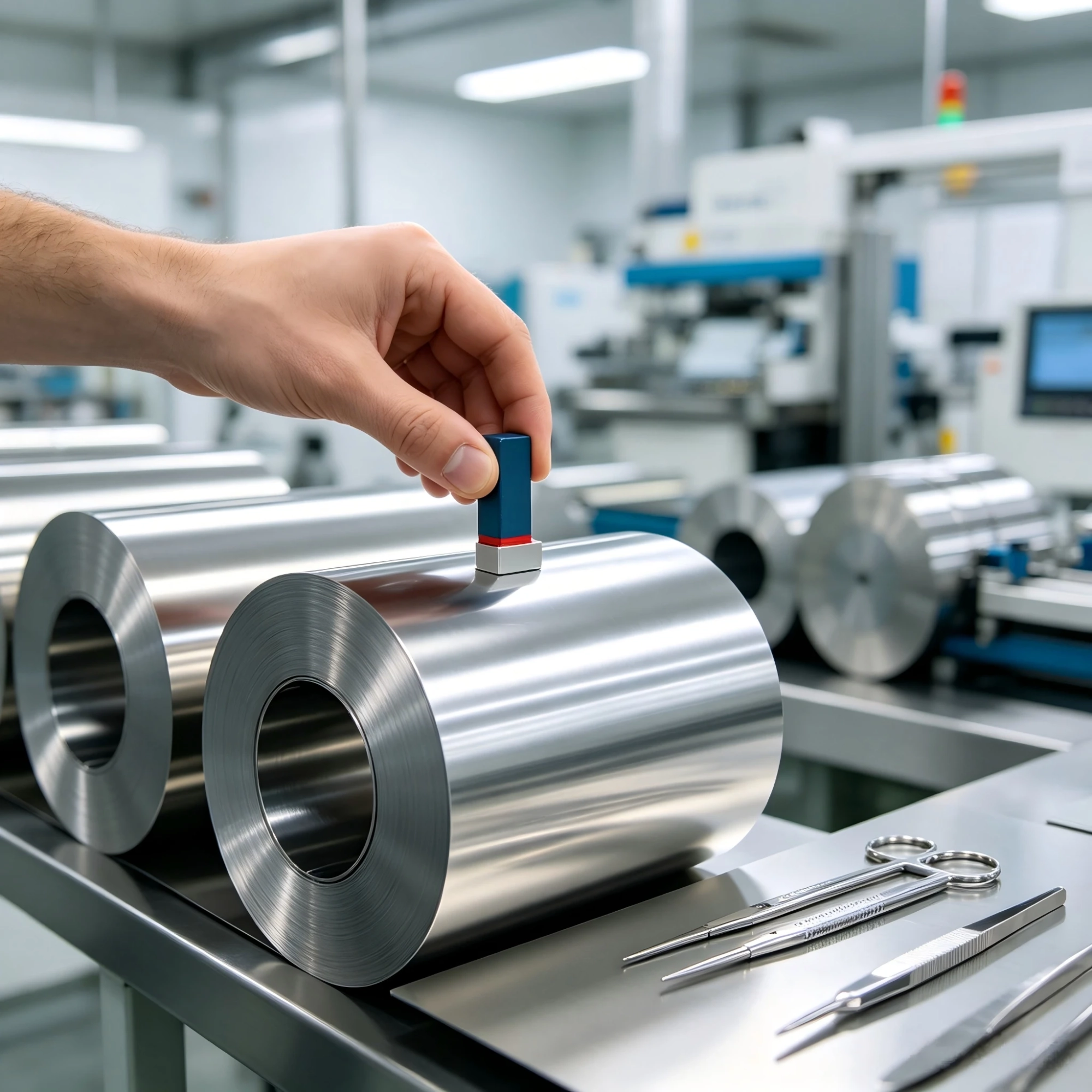
Non-magnetic stainless steel commonly refers to austenitic grades such as 304 and 316 that show low magnetic response in the annealed condition. Cold forming and welding can change that response, so the grade and processing history both matter when selecting material.
For a formed component, consider magnetic performance together with corrosion resistance, strength and formability. This guide compares the main stainless steel families and common grade choices, explains how processing affects magnetism, and helps you identify the appropriate material and testing requirements.
For material selection, confirm three things: the grade or proprietary material, its processing condition, and the magnetic acceptance requirement for your application.
What Does Non-Magnetic Stainless Steel Mean?
In purchasing and engineering, “non-magnetic” usually means a low magnetic response that is acceptable for the intended use. Austenitic stainless steel generally has low magnetic attraction in the annealed condition. Its response can change with composition, manufacturing history and local structure.
Relative magnetic permeability, written as μr, is one way to describe magnetic behaviour. A value close to 1 indicates low permeability, but there is no single acceptance limit for every stainless steel product or application. Where a limit is required, the customer must specify the property, test method and applicable conditions.
Low permeability, low residual magnetic field and passing a needle detector are separate requirements. State which one matters to your component rather than using “non-magnetic” as a substitute for all three.
Which Stainless Steel Families Are Magnetic?
Magnetic behaviour depends on the material’s structure. Austenite, ferrite and martensite have different magnetic characteristics; a product can contain more than one phase.
| Family | Examples | Magnetic behaviour to consider |
|---|---|---|
| Austenitic | 201, 202, 304, 316 | Generally low magnetic response when annealed; processing can change the result. |
| Ferritic | 409, 430 | Magnetic because of the ferritic structure. |
| Martensitic | 410, 420 | Magnetic; heat treatment is also important to the required mechanical properties. |
| Duplex | 2205, 2507 | Magnetic because the mixed structure includes ferrite. |
| Precipitation hardening | 17-4 PH, 17-7 PH | Depends on grade and treatment condition; do not assume low magnetic response. |
A magnetic result does not by itself show that stainless steel is poor quality or the wrong material. Some magnetic grades are deliberately selected for their strength, hardness or corrosion performance. Match the complete specification to the job.
Choosing a Grade for Low Magnetic Response
Start with the service environment and manufacturing process. The following grade groups help narrow the selection; include the required form, dimensions and condition in your enquiry so suitability and availability can be confirmed for the order.
| Grade group | Selection focus | Order and application requirements |
|---|---|---|
| 201 / 202 | Manganese-containing austenitic grades considered for suitable general and decorative uses. | Corrosion environment and magnetic response after the intended cold forming. |
| 304 / 304L | Common choices for general forming and corrosion-resistant components. | Supply condition and local response at formed or worked areas. |
| 316 / 316L | Molybdenum improves resistance to pitting and crevice corrosion in suitable chloride-containing environments compared with 304. | Consider chloride exposure, temperature and component geometry alongside the required magnetic response after forming. Improved corrosion resistance does not by itself establish lower magnetic permeability. |
| 310 / 310S, 321, 347, 904L | 310/310S addresses elevated-temperature oxidation. Stabilized grades 321 and 347 address sensitization-related corrosion. 904L serves selected demanding corrosion environments. | Choose according to the actual thermal or corrosion conditions, then assess magnetic performance in the required material condition. These grades address different service needs and are not interchangeable solely because they are austenitic. |
Compare corrosion resistance, forming response, required strength and cost together with magnetic performance. Low-carbon variants can help with welding-related sensitization concerns; the finished component’s permeability should be assessed under the specified conditions.
For a more detailed comparison of individual grades, use our 304, 316, 310, 321 and 904L selection guide.
Why Processing Can Change Magnetic Behaviour
Cold Forming and Machining
Cold rolling, bending, drawing and other deformation can introduce magnetic martensite in susceptible austenitic steels. The amount depends on composition and processing conditions. An unformed area and a heavily worked feature may therefore give different results on the same part.
Welding and Local Structure
Austenitic weld metal can contain ferrite. The magnetic result of a welded assembly therefore needs to be assessed at relevant locations, rather than inferred from the parent material’s grade alone.
Heat Treatment and Demagnetizing
Where appropriate for the grade and component, solution heat treatment can reverse strain-induced martensite. Review its effects on strength, dimensions and finish before selecting the cycle and any subsequent operations.
Demagnetizing addresses retained magnetization; it does not change a magnetic phase into austenite or automatically establish low permeability. Confirm whether the requirement concerns residual field, permeability or both.
If a component develops unexpected attraction after manufacturing, our guide to austenitic stainless steel becoming magnetic covers the issue in more detail.
How to Verify the Required Performance
A hand magnet provides a qualitative screening result. It cannot identify the grade or supply a numerical permeability value. Chemical analysis checks composition, while a suitable permeability method assesses the specified magnetic property.
Agree the instrument or method, specimen requirements, test locations and acceptance rule before testing. Ferrite content and relative permeability are different measurements and should not be substituted for one another.
Our stainless steel magnetic testing guide explains how to select a method and record results.
Applications: Define the Requirement Before Choosing Material
- Buttons and zipper components: consider forming, surface finish and any finished-goods inspection requirement.
- Consumer electronics and sensor-related components: define the magnetic property and operating conditions that matter to the design.
- Decorative and general formed parts: balance appearance, corrosion resistance, strength and fabrication needs; low magnetic response may be only one consideration.
For garment hardware, include the buyer’s finished-goods needle-detection procedure alongside any permeability requirement. Our needle-detection material selection guide explains the details to provide.
For regulated applications, include the applicable end-use material, inspection and qualification requirements in the specification.
Buyer Checklist for Material Enquiries
- Application and environment: describe the component, exposure conditions and intended use.
- Material: specify the grade or proprietary designation, or ask for selection support.
- Dimensions and condition: provide thickness, width or profile, tolerances, finish and required strength or temper.
- Manufacturing process: explain forming, welding, machining, plating or other operations after delivery.
- Magnetic acceptance: state the required property, method, limit or agreed comparison, and the stage at which it applies.
- Verification and records: agree sampling, traceability and required test reports or certificates.
- Order details: include quantity, destination and requested delivery date.
For requirements that apply after manufacturing, approve representative samples through the intended process. Agree the test results, material certificate and traceability records to be supplied with production orders.
Frequently Asked Questions
Is 304 stainless steel always non-magnetic?
No. Annealed 304 generally has low magnetic response, but forming and other processing can change the local structure. Assess the supplied condition and the finished component against the actual requirement.
How should I compare 304 and 316 for magnetic requirements?
Both grades generally have low magnetic response when annealed. Cold working can increase permeability by forming magnetic martensite in susceptible material. The result depends on composition, deformation and processing conditions. Compare the grades in the condition your component will actually use, while also considering corrosion resistance and formability.
Does non-magnetic stainless steel resist all corrosion?
No. Corrosion performance depends on the grade, surface condition, environment and service conditions. Low magnetic response is not a corrosion rating.
Is FPD806 another name for 304 or 316L?
FPD806 is Fullgreat’s proprietary non-magnetic stainless steel designation. Use its own product specifications when evaluating dimensions, material condition and performance for your application.
Explore FPD806 Non-Magnetic Stainless Steel Strip and Coil
Fullgreat supplies proprietary FPD806 as strip and coil for applications including buttons, zipper components, apparel accessories and selected electronic parts. Review the product page for dimensions, finishes, forming conditions and supply options.
Send your application, drawing, quantity and magnetic or inspection requirements so suitability and order conditions can be confirmed.