Blog
Non-Magnetic Materials for Needle Detection: A Sourcing Guide for Garment Hardware

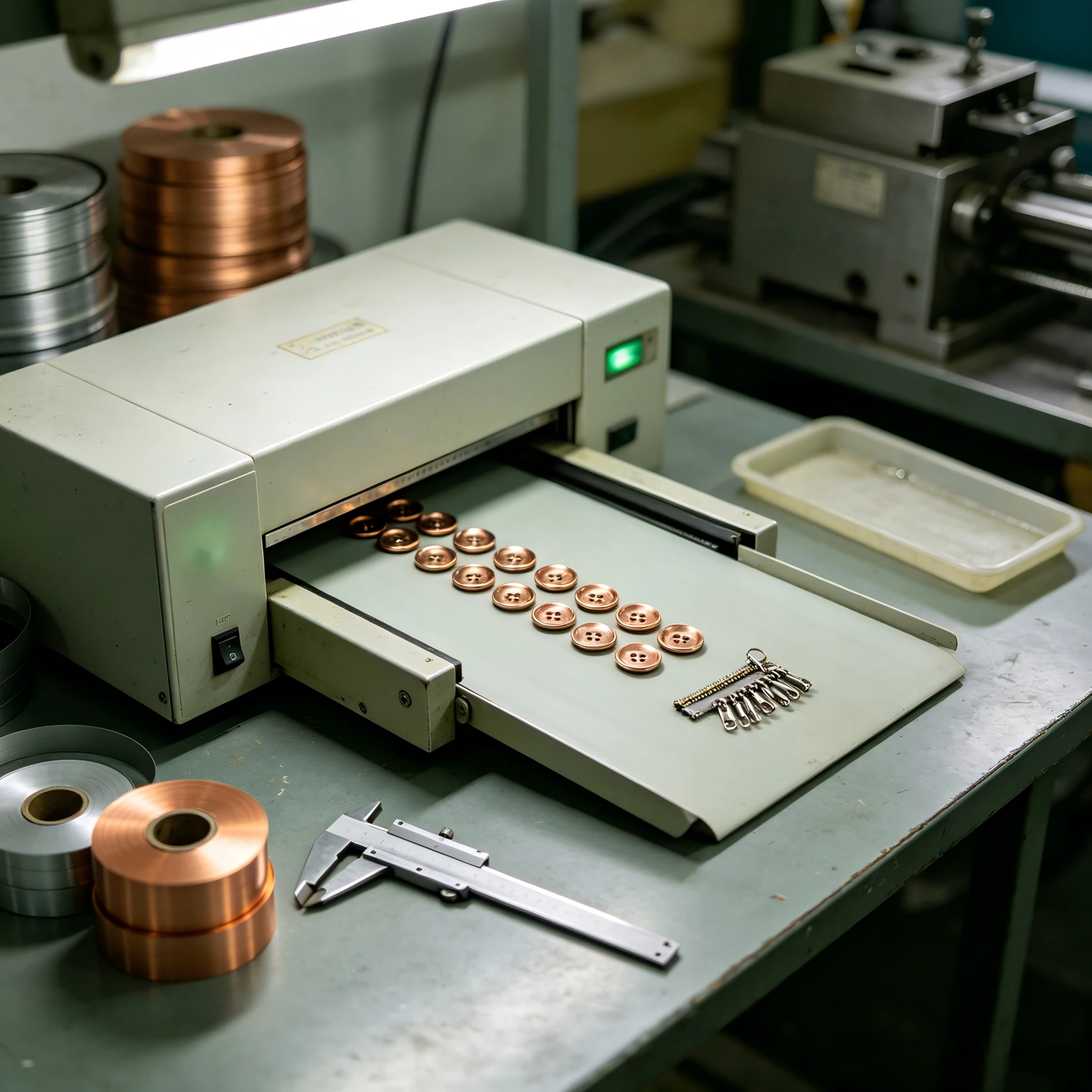
For exporters of garments, toys, bedding and accessories, needle detection is not optional — it is a contract requirement, a customs checkpoint and, when it fails, a recall event. Every piece of metal hardware on the product — zippers, buttons, snaps, rivets, hooks — must pass the same inspection as the fabric, which means the whole supply chain, from the strip mill to the button stamper, has to be built around non-magnetic materials for needle detection. Choosing the wrong material turns a routine QC step into a production headache that no amount of end-of-line sorting can fully fix.
This guide explains how needle detection actually works, which materials genuinely pass 8-level needle inspection, why a part that was non-magnetic at the mill can fail at the finished-goods stage, and what to specify on your purchase order so that zipper and button hardware never triggers the detector again.
Why Needle Detection Exists in the Garment Industry
Needle detection began as a safety measure in textile production. Broken sewing needles, snapped pins, fragments of metal tooling and stray staples can end up inside finished garments, bedding, toys and plush products. These products sit against the skin — and in the case of toys, they go into children’s mouths — so manufacturers and brand buyers install needle detection machines at the end of the production line to reject any item that contains ferromagnetic metal.
For export markets, particularly the EU, US and Japan, the requirement has hardened into a standard practice: the finished product passes through a machine calibrated to the highest sensitivity level — the 8-level needle detection test — and any item that triggers the alarm is rejected and quarantined. Passing this test consistently is a precondition for shipping to most major retail buyers, and the requirement extends to the metal accessories attached to the product. A magnetic zipper tooth is not a defect of the fabric line; it is a material specification problem that should have been solved at the metal supplier.
How a Needle Detector Works — and What It Actually Catches
A needle detection machine works on a simple electromagnetic principle: it generates a magnetic field in its aperture and measures how objects passing through disturb that field. Ferromagnetic materials — iron, ordinary carbon steel, ferritic and martensitic stainless steel — concentrate the magnetic field lines and trigger the detector. The sensitivity setting determines how small a ferromagnetic particle will set off the alarm; the highest settings are designed to catch fragments far smaller than a typical needle break.
Three consequences follow that matter for material selection:
- The detector cannot distinguish a broken needle from a magnetic zipper tooth. If the hardware itself is magnetic, the machine flags the whole product. Good products are rejected because of the hardware, not because of contamination.
- Genuinely non-magnetic material is invisible to the detector. Hardware made from austenitic stainless steel or non-magnetic composites passes through without triggering the alarm.
- The detector catches weak ferromagnetism that a hand magnet cannot. A fridge magnet only reveals strong attraction; a calibrated needle detector responds to much lower levels of magnetism, which is why materials that feel “non-magnetic” by touch can still fail inspection.
This last point deserves emphasis. The difference between “feels non-magnetic” and “passes 8-level needle detection” is the difference between a qualitative screening tool and a calibrated instrument. For the full technical background on test methods, instruments and standards, see our magnet test & permeability guide.
Which Materials Fail Needle Detection — and Why
| Material type | Needle detection result | Why |
|---|---|---|
| Carbon steel / iron (plated or coated) | Fails | Strongly ferromagnetic — the core is iron |
| Ferritic stainless (430 etc.) | Fails | Ferritic (BCC) structure is magnetic by design |
| Martensitic stainless (420 etc.) | Fails | Hardened martensite is magnetic |
| Austenitic stainless (304, 316, 201) — annealed | Passes | Austenitic (FCC) structure is non-magnetic |
| Austenitic stainless — cold worked | Can fail | Stamping and forming induce martensite, which is magnetic |
| Copper, brass, aluminium | Passes | Non-ferromagnetic by nature |
| Copper clad non-magnetic stainless steel (FPD726) | Passes — 8-level verified | Non-magnetic stainless core with copper surface |
The trap in the middle of this table causes more factory rejections than any other: austenitic stainless steel that has been cold worked. Zipper teeth are stamped, buttons are formed, and the deformation strain converts part of the austenite into martensite — a magnetic phase. The flat, annealed strip passed inspection before forming; the finished part may not. This is why a supplier’s claim of “non-magnetic stainless steel” is only half the answer — the question is whether the material stays non-magnetic after your stamping process.
The Metallurgy: Why Non-Magnetic Materials Stop Being Non-Magnetic
Austenitic stainless steel is non-magnetic because of its crystal structure. The austenite phase has a face-centred cubic (FCC) arrangement, in which the magnetic moments of the atoms cancel out — the material is paramagnetic, with a relative magnetic permeability (μr) close to 1.0. Fully annealed 304 or 316 strip typically measures μr ≈ 1.003, which is far below the threshold of any needle detector.
The problem is that austenite is metastable. When the material is cold worked — stamped, bent, drawn, or even edge-trimmed — mechanical strain can trigger a transformation from austenite to martensite, a body-centred tetragonal (BCT) phase that is magnetic. The more severe the deformation, the more martensite forms. A zipper tooth stamped from 304 strip can develop enough martensite at the formed corners to trip a needle detector, even though the same strip was non-magnetic on the shelf.
Different grades behave very differently under cold work:
- 304 / 201 — high susceptibility. Significant martensite forms after 20-30% cold reduction; 201 can become strongly magnetic after moderate forming.
- 316 / 316L — moderate susceptibility. Higher nickel and molybdenum stabilise the austenite; less martensite, but severe forming can still cause problems.
- 310 / 904L — very low susceptibility. Very high nickel content makes the austenite stable enough to survive most forming operations.
For stamped garment hardware, this leaves three practical strategies: choose a more stable grade, specify a final solution-annealing treatment after forming to restore the fully austenitic structure, or use a material whose non-magnetic performance does not depend on resisting strain — such as a composite with a non-magnetic core. For the complete metallurgy, see our non-magnetic stainless steel definitive guide.
Why “Looks Copper” Matters in Garment Hardware
Garment hardware is a design surface as much as a functional part. Buttons, zipper sliders, rivets and ornaments are specified in copper, gold, nickel and antique finishes, and the quickest way to deliver those finishes on a strong, needle-safe part is to start with a material that is both non-magnetic and copper-surfaced.
This is exactly what copper clad stainless steel (FPD726) is built for: a copper or brass outer layer bonded to a non-magnetic stainless steel core. It combines the properties that garment hardware buyers actually need:
- 8-level needle detection compliance — the entire composite, including the core, is non-magnetic, so the finished part passes inspection regardless of forming strain in the surface layer.
- Copper appearance and electroplating performance — gold, nickel, antique bronze and black finishes plate exactly like solid copper, because the surface is real copper.
- Material cost of roughly 40-50% of pure copper — a decisive advantage when copper prices are high and stable costing matters.
- Stainless steel strength — teeth and components hold their shape under repeated opening, closing and laundering.
FPD726 is the material behind needle-safe copper-finish hardware: it gives you the design finish, the inspection compliance and the cost control at the same time. For the full comparison against solid copper, see our copper clad stainless steel vs pure copper guide.
Choosing the Right Needle-Safe Material for Your Part
| Garment hardware part | Recommended material | Key requirement |
|---|---|---|
| Zipper teeth & sliders (copper finish) | FPD726 copper clad stainless steel wire / strip | Non-magnetic after stamping + copper look |
| Buttons, snaps, rivets (copper finish) | FPD726 copper clad stainless steel strip | Needle-safe + electroplating performance |
| Zipper teeth (silver / steel look) | Annealed austenitic stainless strip (304L, 316L, 201) | Confirm non-magnetic after forming, or anneal after forming |
| Hardware with nickel / gold finish | FPD726 or austenitic stainless + plating | Non-magnetic substrate + compatible plating |
| Any part that must not trigger the detector | Non-magnetic materials only — verify per batch | Batch magnetic documentation |
Application Spotlight: Where Needle-Safe Hardware Is Non-Negotiable
Baby and children’s wear
Infant garments, bibs, soft toys and plush products are subject to the strictest needle detection regimes in the industry. The metal hardware is small, the safety standard is absolute, and a single failed batch can stop a whole season. Non-magnetic materials for needle detection are specified here without exception, and FPD726’s copper-finish option is widely used for decorative babywear buttons.
Hospital bedding and medical textiles
Hospital linen, patient gowns and reusable medical textiles pass through metal detection as part of laundering and sterilisation protocols. Magnetic hardware can also interfere with nearby monitoring equipment in clinical environments, which makes non-magnetic components a functional requirement, not only a QC one.
Export garments and brand compliance
Major retail buyers in the EU, US and Japan audit needle detection records. When the buyer’s inspection standard is written into the contract, the material specification must follow — and the hardware supplier must be able to document magnetic performance per batch.
Luxury luggage and bags
Luggage zippers and hardware face repeated use and airport screening environments. Non-magnetic metal avoids any interaction with security equipment and delivers the premium copper or gold finish that luxury brands specify.
Sourcing Checklist: Specifying Needle-Safe Hardware
- Put the needle detection requirement in writing — specify “must pass 8-level needle detection” on the purchase order, not just “non-magnetic”.
- Require batch magnetic verification — a magnetic permeability reading or needle-detector test for every batch, not a one-time sample.
- Confirm the grade and the condition — for austenitic stainless, specify the annealed condition; for FPD726, confirm the non-magnetic core grade and the surface layer.
- Test finished parts, not just raw material — stamping can make a part magnetic even when the strip was not; verify on formed parts, especially edges and bends.
- Demand documentation you can audit — a Mill Test Certificate with heat number and magnetic data. See our MTC / EN 10204 3.1 explainer for what to check.
- Run a production trial with a sample batch — confirm that the formed hardware passes your customer’s needle detector before committing volume.
Factory Perspective: How Fullgreat Verifies Needle-Safe Materials
Fullgreat Metal supplies the two material families that garment hardware buyers actually use for needle-safe production:
- Non-magnetic stainless steel strip and wire — austenitic grades in the annealed condition, with magnetic permeability verified per batch, in grades from 201 to 304L, 316L and higher-stability alloys.
- FPD726 copper clad stainless steel — the patented three-layer composite (copper or brass over a non-magnetic stainless steel core) in strip and wire form, designed to pass 8-level needle detection.
Since 2008 we have served more than 1,000 enterprises and exported to 20+ countries, with ISO 9001:2015 certification, a monthly capacity of 50,000 tons, an inventory of 10,000 tons and partnerships with 100+ steel mills in Japan, Korea, Germany, Taiwan and China. Every shipment can carry a traceable Mill Test Certificate with magnetic performance data — because for needle-safe hardware, “it should be fine” is not a specification.
See our copper clad stainless steel strip and copper clad stainless steel wire product pages for specifications, or send your part drawings and needle detection requirement to Bruce@fullgreat.com.
Frequently Asked Questions
Q: What is the 8-level needle detection test?
A: It is the highest sensitivity setting on standard needle detection machines, used for export garments, toys and bedding. A product must pass through the machine at this sensitivity without triggering the alarm.
Q: Why does my stainless steel zipper fail needle detection even though it is stainless?
A: If the hardware is made from ferritic or martensitic stainless steel — or from austenitic stainless that was cold worked without annealing — it contains magnetic phases. Stamping zipper teeth induces martensite, which is magnetic. Specify annealed austenitic material and verify on finished parts.
Q: Is copper-plated steel needle-safe?
A: No. Copper plating does not change a magnetic core. If the substrate is carbon steel, the part remains ferromagnetic and will trigger the detector. Use copper clad non-magnetic stainless steel instead.
Q: What is the difference between FPD726 and copper-plated steel?
A: FPD726 uses a non-magnetic stainless steel core with copper bonded to the surface — the entire composite is non-magnetic and passes 8-level needle detection. Copper-plated steel has a magnetic carbon steel core.
Q: Do I need to test every batch?
A: For export production, yes. Material condition can vary between batches, and stamping can introduce magnetism. Require batch magnetic verification and test finished parts.
Q: Can FPD726 be electroplated to gold or nickel finish?
A: Yes. The copper outer layer plates exactly like solid copper, including gold, nickel, antique bronze and black finishes.
Q: Can the non-magnetic property survive stamping?
A> For austenitic stainless, forming can induce martensite, so verify finished parts. For FPD726, the non-magnetic core is protected by the composite structure, which is why it is specified for stamped copper-finish hardware.
Q: What documentation should I request with needle-safe hardware material?
A: A Mill Test Certificate with heat number, chemical composition, and magnetic permeability or needle-detector results for the batch. For critical programmes, request EN 10204 Type 3.2 certification with third-party inspection.
Need needle-safe hardware material for your garment line? Send your part drawings, finishes and needle detection requirement to Bruce@fullgreat.com — we will confirm material, temper and batch magnetic documentation before you commit.