Blog
How to Choose a Stainless Steel Supplier: A Technical B2B Guide (Coil & Sheet)

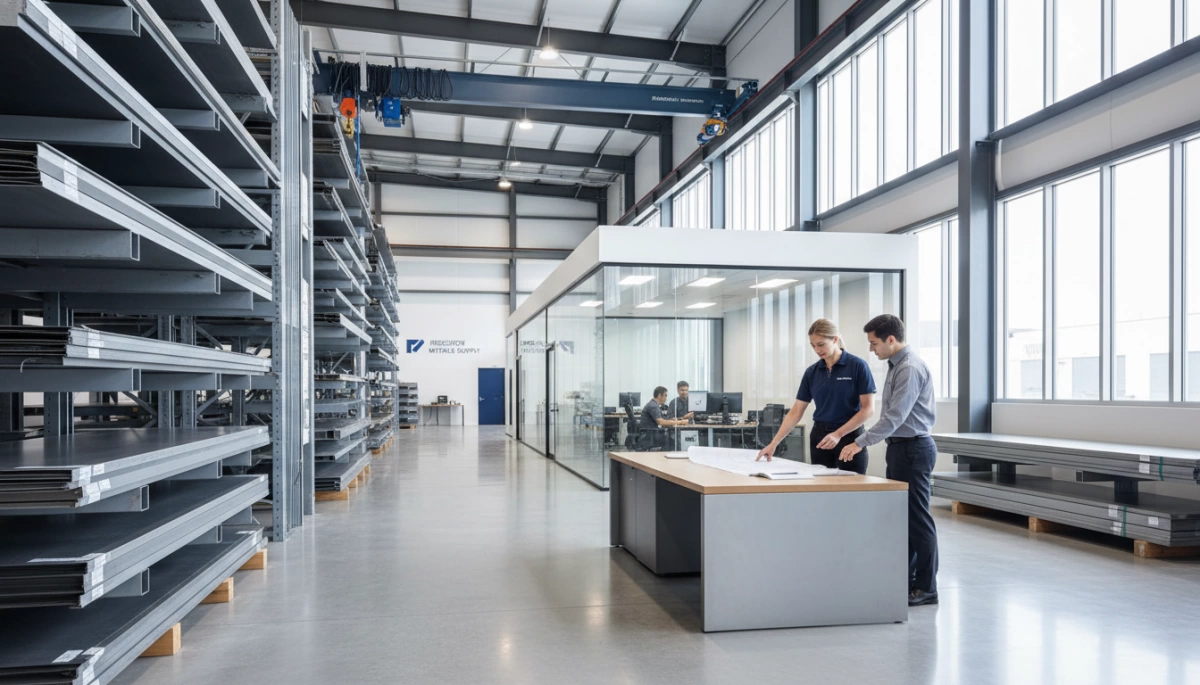
When global procurement managers search for a qualified stainless steel supplier — whether they are buying coil for stamping, sheet for fabrication, or plate for structural work — the decision parameters extend far beyond a simple comparison of base metal quotes. To protect downstream production efficiency, technical buyers look for an integrated manufacturing partner capable of guaranteeing consistent metallurgical properties, precise dimensional tolerances, and bulletproof mill-level certification. This guide walks through the key evaluation criteria — sourcing channels, material grades, surface finishes, certifications, packaging, and processing capabilities — so you can shortlist a supplier with confidence.
For a broader overview of material grades, properties, and applications, refer to our Non-Magnetic Stainless Steel: The Definitive Guide.
Understanding Sourcing Supply Channels
Not all supply routes operate with the same engineering capabilities. To properly manage overhead costs and material supply risks, it is critical to classify your prospective stainless steel supplier by their operational scale:
- Stainless Steel Manufacturer (Integrated Mill): Runs direct cold-rolled mill runs, controlling internal chemical grain alignments from the melt slab down to thin gauges and master coils. Best for secured, long-term contractual pricing, heavy OEM/ODM volume distributions, and custom coil/sheet sizes.
- Wholesale Stockist & Distributor: Maintains a large footprint of ready stock standard blanks and slit coils. Ideal for frequent repeat consumption patterns and short-notice project distributions, but lacks direct custom alloying capabilities.
- Commercial Broker / Trader: Acts as a middle tier. While flexible for small mixed-material pallets, they possess zero direct quality verification controls over tool wear or surface inconsistencies.
At Fullgreat Metal, we bridge the gap by operating as a manufacturer-stockist hybrid—delivering mill-level price advantages alongside agile, in-house slitting, leveling, and processing services.
Core Technical Properties of Industrial Flat Steel
When engineering panels or feeding high-speed press lines, specifying flat metal stock requires matching exact grade chemistry to the final structural application environment. All our grades conform to the recognized ASTM A240 and EN 10088-2 standards.
Evaluating Material Grade Attributes
- 304 / 304L (General Purpose Baseline): The global workhorse for industrial food contact, cleanroom enclosures, and basic kitchen frameworks. Highly formable but prone to localized pitting if exposed to marine environments.
- 316 / 316L (High-Corrosion Sea Grade): Formulated with specialized Molybdenum (Mo) targets to withstand aggressive chlorides and intense chemical sanitization. Mandatory for coastal infrastructure and maritime piping. We cover the low-carbon marine variant in detail in our 316L stainless steel strip deep-dive.
- 201 & 430 (Cost-Sensitive Solutions): 201 offers elevated structural stiffness via manganese additions but lower corrosion thresholds, while 430 is a magnetic, ferritic alloy optimized for indoor household appliance facades.
If your project demands completely non-ferromagnetic attributes to insulate sensitive sensors or medical imaging setups, it is crucial to review specialized technical metrics on our dedicated non-magnetic stainless steel specifications page to balance permeability indices. You can also verify incoming material with the test methods described in our guide to testing if stainless steel is non-magnetic.
Surface Finishes and Protective Processing Controls
The specified face condition of your alloy influences its cleanability, resistance to micro-abrasions, and overall surface roughness (Ra) footprint:
- 2B Matte Finish: A smooth, unpolished look directly resulting from cold rolling, annealing, and pickling. The default, cost-effective baseline for chemical tanks, hidden brackets, and industrial backing structures.
- BA (Bright Annealed) Finish: Produced in a vacuum or controlled-atmosphere annealing furnace, BA yields a bright, mirror-like finish directly from the mill — no mechanical polishing required. It is the standard for premium appliance and automotive trim, especially on coil-fed lines.
- No.4 Brushed Finish: Features a continuous linear mechanical grain that excellently masks fingerprints and handling scratches. Standard for touch-surfaces, commercial elevator cars, and kitchen exhaust hoods.
- No.8 Mirror Polished Finish: Highly reflective, flawless face orientation designed for luxury architectural cladding and high-visibility branding signatures.
⚠️ Critical Surface Protection Protocol
To ensure pristine delivery without handling scars, any reliable stainless steel supplier must execute a rigorous laser-film application routine. At Fullgreat Metal, we wrap all brushed and mirror-polished faces with premium PE/PVC protective barriers designed to withstand the heat and mechanical stress of automated laser-cutting nozzles, completely removing post-transit grinding overheads.
Export Packaging: Preventing Ocean-Freight Oxidation
For long sea voyages, coils and sheets are exposed to repeated condensation cycles inside the container (“container rain”). To protect the finish, every export order is packed with:
- Volatile Corrosion Inhibitor (VCI) film wrapped around the metal to block oxidation;
- Desiccant packets placed inside to absorb residual moisture;
- An eye-to-wall loading layout that prevents moisture pooling and allows air circulation.
Together these measures prevent condensation stains and keep the surface intact from mill to your receiving dock.
December 2026 Volume Surcharge Guide (FOB China Main Ports)
*Operational Pricing Notice: Below are reference bulk-wholesale parameters across standard dimensions. Prices are indicative and should be confirmed against current LME indices before quoting. For ongoing product integration or mixed-material layouts, explore our complete stainless steel coil/strip/plate category page.
| Material Group | Available Formats & Finishes | Thickness Range Tolerance | FOB China Price Range |
|---|---|---|---|
| Commercial 201 Grade | CR Coil / Sheet, 2B & Brushed | 0.4 mm – 3.0 mm (Standard) | USD 1.40 – USD 1.80 / kg |
| Austenitic 304 / 304L | CR/HR Sheet, 2B, No.4, Mirror | 0.5 mm – 6.0 mm (ASTM A240) | USD 2.20 – USD 2.50 / kg |
| Marine 316 / 316L | CR/HR Plate, 2B, No.1, Pickled | 0.8 mm – 12.00 mm (Precision) | USD 3.00 – USD 3.50 / kg |
| Ferritic 430 Grade | CR Sheet, 2B, BA, No.4 Finish | 0.4 mm – 2.0 mm (Magnetic) | USD 1.20 – USD 1.50 / kg |
Vetting Your Vendor Sourcing Pipeline: 4 Non-Negotiables
To establish a zero-defect procurement flow across international borders, incoming quality control engineers should evaluate four core benchmarks:
- Traceable MTC Compliance: Mandate a verified EN 10204 3.1 certification packet with every single batch shipment. The MTC must display authentic chemical heat logs (Cr, Ni, Mo, C) and tensile profiling data matching EN/ASTM tolerances.
- In-House Processing Precision: Check if your vendor supports custom cut-to-size shearing, automated slitting, and laser profiling. Our in-house slitting lines convert wide master coils into narrow precision strip with burr-free edges, plus cut-to-length sheets and custom widths — protecting your stamping dies from premature wear.
- Grain & Tension Control: Verify the mill achieves uniform planar grain refinement (to prevent orange-peel and wall cracking during deep drawing) and uniform coil tension with flat profiles for stable press feeds.
- Environmental Validation: For marine components, ask for salt spray testing metrics and edge passivation to confirm the passive chromium layer stays intact over multi-year cycles.
Cross-Material Sourcing Simplification
For large architectural cladding or mixed manufacturing layouts, we coordinate bundled logistics across multiple raw portfolios to consolidate freight. Importers can securely combine premium alloy sheet with specialized assets from our alternative aluminum coil and plate range or structural round bar and hot-rolled runs, drastically decreasing handling times at incoming ports.
Frequently Asked Questions
Q: What is the minimum order quantity (MOQ) for stainless steel?
A: MOQ varies by supplier and grade. Integrated mills typically require volume commitments (often 5–20 tons per grade/spec), while stockists and distributors may offer smaller quantities or even sample blanks. At Fullgreat Metal, trial orders and sample quantities are available for prototype development, with volume production supported through monthly supply contracts. Always confirm MOQ, lead time, and payment terms in writing before placing an order.
Q: How do I verify a stainless steel supplier is legitimate?
A: Verify four things: (1) a valid EN 10204 Type 3.1 mill test certificate accompanying each batch, (2) an ISO 9001 quality management certification, (3) third-party inspection options (SGS, TÜV, BV) for critical orders, and (4) physical or video verification of their facility. A supplier who refuses to provide test documentation or facility proof should be treated as a red flag.
Q: What is the typical lead time for stainless steel orders?
A: Standard stock sizes from a distributor can ship within 1–2 weeks. Custom sizes, special finishes, or mill-direct production runs typically require 3–6 weeks depending on grade availability and manufacturing capacity. Confirm the lead time and freight schedule as part of your RFQ to avoid production delays.
Q: Can I order stainless steel with custom dimensions and finishes?
A: Yes. A manufacturer or manufacturer-stockist hybrid can provide custom cut-to-size shearing, slitting, laser cutting, edge rounding, and specified surface finishes (2B, BA, No.4, No.8, or custom Ra targets). Be sure to specify your thickness, width, length, finish, and tolerance requirements in the RFQ, along with any magnetic permeability requirements if applicable.
Q: What is the difference between 2B and BA finish?
A: 2B is a cold-rolled, pickled, lightly skin-passed matte finish — the standard industrial choice for hidden brackets and general fabrication. BA (Bright Annealed) is produced in a vacuum annealing furnace for a bright, mirror-like finish used on premium appliance and automotive trim.
Q: Does the supplier’s location affect stainless steel quality?
A: Not directly — quality is determined by mill standards, process control, and inspection (ASTM A240, EN 10088-2), not geography. A factory-direct supplier with audited processes and traceable heat numbers can deliver quality equal to any global source at better wholesale pricing.
Lock in your direct factory metal quotation within 12 hours. LME raw indices and ocean freight matrices adjust dynamically. Review our mill processing metrics and dimensional charts on our official stainless steel products catalog page, or submit your comprehensive RFQ (Grade, Thickness, Surface Finish, and Size Dimensions) directly to our engineers at Bruce@fullgreat.com to secure an aggressive wholesale offer.