Blog
High Strength Steel Strip: Complete Grade & Temper Guide

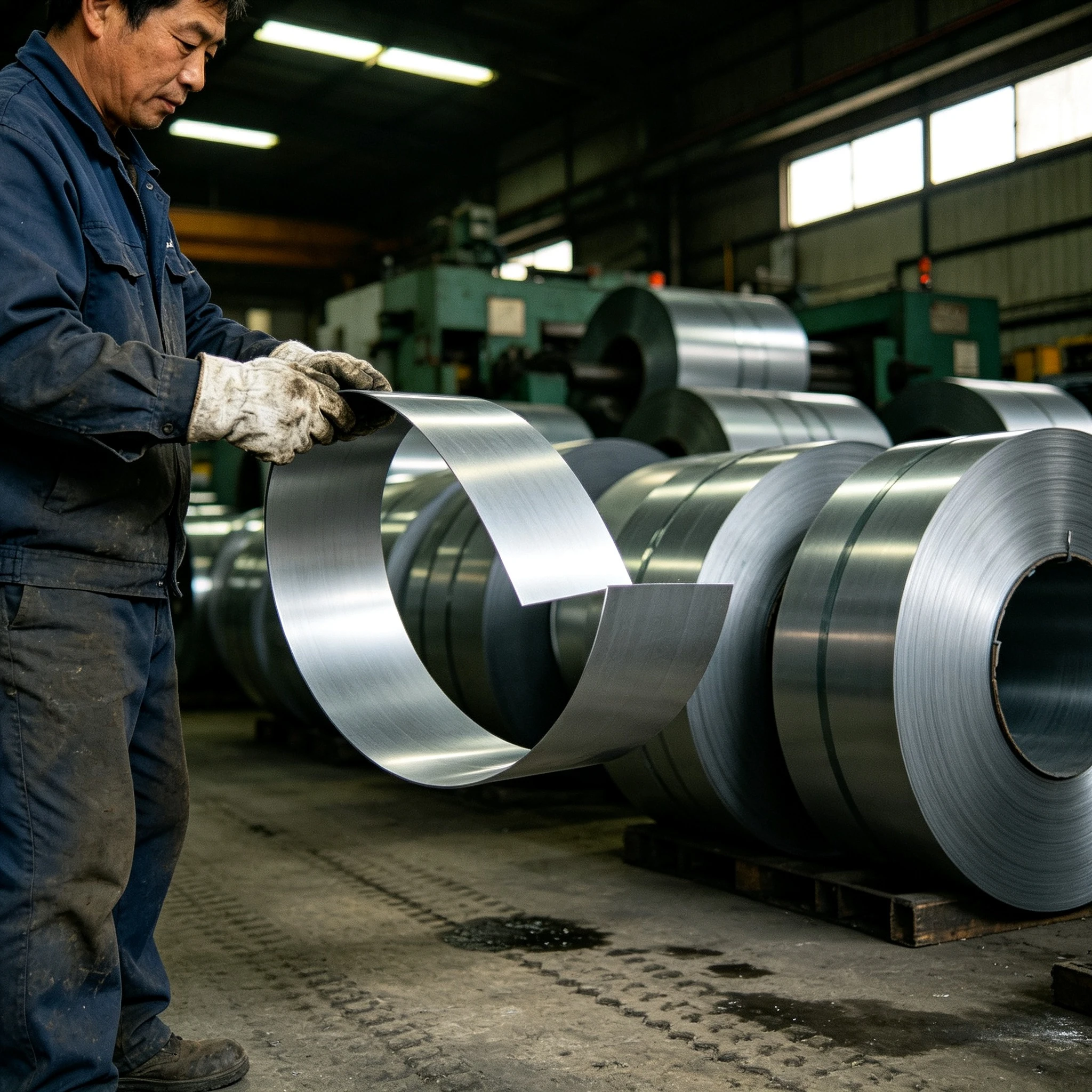
High strength steel strip is specified wherever a thin metal component must carry serious load, survive repeated stress or hold precise geometry under force — automotive structural parts, springs, saw blades, relay springs, bearing cages and precision stampings. The phrase covers a wide band of materials, from low-alloy high-strength (HSLA) strip at 490–780 MPa to precipitation-hardened stainless strip above 1,500 MPa, and choosing the right grade is a strength-versus-formability decision, not a price decision. This guide maps the strength ranges, names the grades that deliver each one, and gives you the sourcing checklist to buy high strength steel strip with traceable hardness documentation.
The Strength Map: How High-Strength Strip Is Organised
High strength steel strip is best understood as four strength bands. Each band has its own material families, processing routes and forming limits. The table below is the decision map used by design engineers and buyers.
| Strength band | Yield / tensile (typical) | Material families | Typical applications | Forming behaviour |
|---|---|---|---|---|
| HSLA & micro-alloyed | 490–780 MPa | HSLA 350/450/550, micro-alloyed C-Mn | Automotive brackets, structural profiles, pipe clamps | Good — stampable, roll-formable |
| Quenched & tempered spring steel | 800–1,500 MPa | 65Mn, SK5, C67S/C75S, AISI 1074/1075/1095 | Springs, clips, retaining rings, blades, washers | Limited — annealed for forming, then heat-treated |
| Cold-worked austenitic stainless | 1,130–1,400+ MPa | 301, 304 full-hard / spring-hard tempers | Constant-force springs, EMI spring contacts, precision clips | Fair — stamp in temper, limited deep drawing |
| Precipitation-hardened / ultra-high | 1,400–2,000+ MPa | 17-7PH (CH900), martensitic age-hardening steels | Aerospace springs, high-load fasteners, tooling | Conditioned then aged; verify final magnetic state |
The single most common specification error is ordering “high strength strip” without naming the strength band — the supplier quotes HSLA and the part fails in spring service. Always write the yield or tensile target in MPa and the temper in words.
Band 1: HSLA and Micro-Alloyed High-Strength Strip (490–780 MPa)
High-strength low-alloy (HSLA) strip achieves 490–780 MPa yield through micro-alloying elements — niobium, vanadium and titanium — that refine the grain structure without the cost of heavy alloying. It is the default for automotive structural parts, brackets, reinforcements and any formed component that needs higher strength than plain carbon steel without the formability penalty of spring steel.
HSLA strip is supplied in the cold-rolled and annealed condition, stamps and roll-forms well, and is weldable. Its strength comes from composition and controlled rolling rather than heat treatment, so it arrives ready to use. If your part is a bracket, clamp, reinforcement or structural profile rather than a spring, this is the band to specify.
Band 2: Spring Steel Strip — The 800–1,500 MPa Workhorse
Spring steel strip covers the widest commercial volume of high strength strip. Carbon contents from 0.60% to 1.03% allow hardening to much higher strength than HSLA, at the cost of formability — which is why spring steel is usually stamped in the annealed or skin-passed condition and heat-treated after forming. The common designations and their carbon ranges are covered in depth in our high carbon spring steel strip guide; the short version is:
- 0.60–0.70% C (65Mn, SK7, C67S) — formable springs, clips, washers, clutch parts.
- 0.70–0.80% C (SK5, C75S, AISI 1074/1075) — balanced formability and hardness for general springs and stampings.
- 0.90–1.03% C (AISI 1095) — maximum hardness and wear resistance for blades, cutting edges and high-hardness springs.
Specify the hardness range in writing (HRC or HV), the condition (annealed, hard-rolled, quenched and tempered), and confirm it on the Mill Test Certificate — hardness drift between batches is the most common cause of spring failure downstream.
Band 3: Cold-Worked Austenitic Stainless Strip (1,130–1,400+ MPa)
When the part needs strength and corrosion resistance together — or must stay non-magnetic — cold-worked austenitic stainless strip is the answer. Cold rolling 301 or 304 raises tensile strength into the 1,130–1,400 MPa range through work hardening, in controlled tempers: half-hard (780–930 MPa), full-hard (1,130–1,320 MPa) and spring-hard (1,400+ MPa). 301 work-hardens faster and reaches spring-hard at lower reduction; 304 allows deeper forming before hardening. The temper system and cold reduction control are explained in our extra hard stainless steel strip guide, and the underlying metallurgy — how cold reduction ratio drives hardness — in our cold rolling reduction ratio guide.
One property deserves special attention for this band: magnetic response. Austenitic strip is non-magnetic when annealed, but heavy cold working transforms some austenite into strain-induced martensite, which is magnetic. A spring-hard 301 contact can show a noticeable magnetic pull at formed edges. If the component operates near sensors or electronics, specify a higher-nickel grade such as 316L in hard temper, or verify permeability on the finished part. For the grade-by-grade comparison of the non-magnetic family, see our non magnetic stainless steel grades compared guide.
Band 4: Precipitation-Hardened and Ultra-High-Strength Strip (1,400–2,000+ MPa)
Above 1,400 MPa, the material families change completely. 17-7PH stainless reaches tensile strengths around 1,650 MPa in the CH900 condition — precipitation-hardened to extreme strength with good corrosion resistance and heat tolerance up to 343°C. It is the go-to for aerospace springs, high-load clips and components where failure is not an option. Two caveats matter:
- Heat treatment is the strength: 17-7PH is supplied in Condition A (annealed), Condition C (cold-rolled) or CH900 (aged). The strength exists only in the correct condition — specify it explicitly.
- Magnetic state changes with ageing: the ageing treatment that creates ultra-high strength moves the structure toward martensite, raising magnetic permeability. If the part must be both ultra-strong and non-magnetic, verify the actual μr rather than assuming.
The spring-specific comparison of 301 and 17-7PH — tempers, strength, operating temperature and cost — is covered in our 301 vs 17-7PH spring steel guide. Martensitic age-hardening steels reach even higher strengths (1,800–2,000+ MPa) for specialised tooling and aerospace, but are niche, expensive, and formable only in the soft condition.
Ultra-High-Strength Steel Strip: When You Actually Need It
Ultra-high-strength steel strip (above ~1,400 MPa) is justified when three conditions are met together: the section is thin, the load is high, and weight or envelope is constrained. Typical cases are constant-force springs in actuators, high-load EMI contacts, aerospace control springs, safety-critical clips and wear parts that must hold geometry under cycling. If the part has room to be thicker, a lower band usually wins on cost and formability — over-specifying strength is as expensive as under-specifying it, because the upper bands cost more per kilogram and are harder to form and to source in tolerance.
Strength vs Formability: The Trade-Off Table
| Requirement | Recommendation | Why |
|---|---|---|
| Formed bracket, no heat treatment | HSLA 490–780 MPa | Stamps and roll-forms without post-processing |
| Spring that returns after deflection | 65Mn / SK5 / 1095, heat-treated | Elastic limit + fatigue life after quench and temper |
| Corrosion-resistant spring or clip | 301 full-hard / spring-hard | Strength + corrosion in one material |
| Non-magnetic spring near electronics | 316L hard temper (verify μr) | Strength with stable low permeability |
| Ultra-high load, high temperature | 17-7PH CH900 | 1,650 MPa with heat tolerance to 343°C |
| Thin-section high-load structural part | Cold-rolled HSLA or quenched & tempered strip | Highest strength per unit thickness at reasonable cost |
Buying High Strength Steel Strip: The Sourcing Checklist
High strength strip fails on the shop floor more often from loose specifications than from bad material. Put these five points in writing on every enquiry:
- Strength target in MPa, not adjectives — “high strength” means nothing; 700 MPa yield or 1,400 MPa tensile means something.
- Grade + standard together — 65Mn (GB/T 1222) vs SK5 (JIS G4401) vs AISI 1095 (ASTM A684) are not interchangeable without confirming properties.
- Temper / condition in writing — annealed, hard-rolled, quenched & tempered, or aged (for PH grades). The condition is half the specification.
- Hardness range and tolerance — HRC or HV target, plus thickness tolerance (±0.01 mm on precision slitting) and edge condition (deburred or rounded) for high-speed stamping.
- Mill Test Certificate with heat number — traceable chemistry, mechanicals and hardness, coil by coil. If you need a refresher on what a 3.1 certificate must contain, see our MTC / EN 10204 3.1 explainer.
Fullgreat Metal — the Shenzhen branch of Hong Kong FGI Group — supplies high strength steel strip across all four bands: HSLA, spring steel (65Mn, SK5, SK7, C67S/C75S, AISI 1074/1075/1095), cold-worked austenitic stainless (301, 304, 316L in full-hard and spring-hard tempers) and 17-7PH, with precision slitting, custom widths, deburred edges and heat-numbered Mill Test Certificates. With ISO 9001:2015 certification, a monthly capacity of 50,000 tons, 10,000 tons of inventory and partnerships with 100+ steel mills in Japan, Korea, Germany, Taiwan and China, we have supplied precision strip to more than 1,000 enterprises across 20+ countries since 2008. For the non-magnetic side of the range, see our non-magnetic stainless steel definitive guide.
For high strength material in wire form — spring steel, stainless and carbon flat wire — see our complete flat wire guide.
Frequently Asked Questions
Q: What is the strongest high strength steel strip?
A: Among commercial grades, 17-7PH in the CH900 condition reaches about 1,650 MPa tensile, and martensitic age-hardening steels exceed 1,800 MPa. Among carbon steels, AISI 1095 quenched and tempered is the highest-hardness option. Among cold-rolled stainless, spring-hard 301 reaches 1,400+ MPa.
Q: What is the difference between high strength steel and spring steel strip?
A: Spring steel is a subset of high strength strip with an elastic-limit requirement — it must return to shape after deflection. High strength steel strip is the wider category covering HSLA structural strip, spring steel, cold-worked stainless and precipitation-hardened grades. Spring steel is heat-treated for elasticity; HSLA is strengthened by micro-alloying and controlled rolling.
Q: Can high strength steel strip be bent or stamped?
A: Yes, but the higher the strength band, the less formability. HSLA stamps and roll-forms well. Spring steel is formed in the annealed condition and heat-treated after forming. Spring-hard stainless strip is stamped for flat components with minimal bending. Specify the temper to match your forming process.
Q: Is high strength steel strip magnetic?
A> Carbon and alloy high strength strip (HSLA, spring steel, PH grades) is magnetic. Cold-worked austenitic stainless strip is non-magnetic in the annealed condition but can develop local magnetism from strain-induced martensite under heavy cold work. For guaranteed non-magnetic high strength, use higher-nickel grades like 316L hard temper and verify permeability.
Q: What tolerances can precision slitting hold on high strength strip?
A> On precision slitting lines, thickness tolerance can be held to ±0.01 mm and width to tight custom dimensions, with deburred or rounded edges available for high-speed stamping. Confirm the tolerance and edge condition in writing — they matter as much as the grade for high-strength strip.
Need high strength steel strip with a confirmed strength band and traceable MTC? Send your MPa target, grade, temper, dimensions and quantity to Bruce@fullgreat.com and we will confirm availability, hardness range and certification before you commit.