Blog
High Carbon Spring Steel Strip Guide

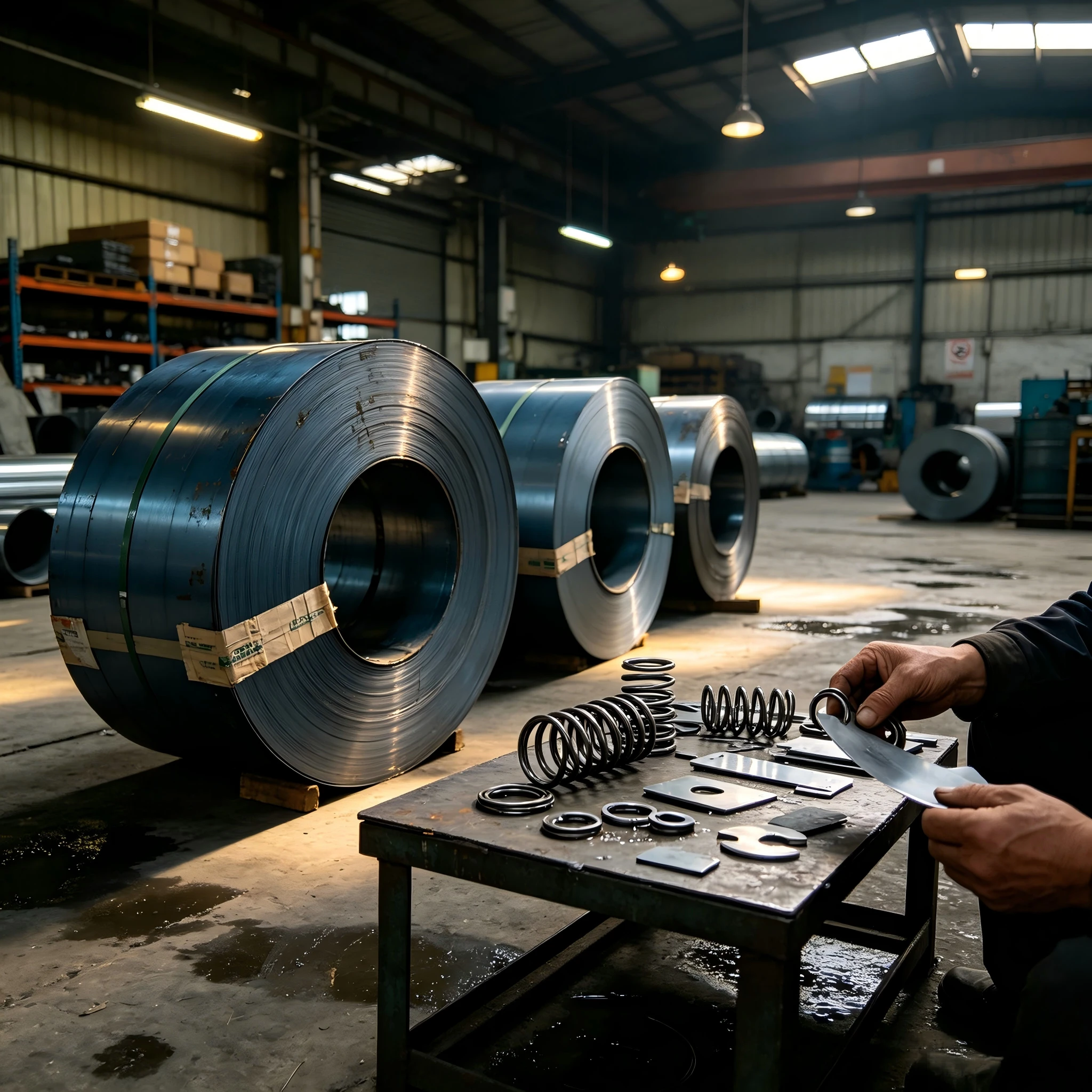
High carbon spring steel strip is the workhorse behind the springs that hold, release and return force in everything from automotive seat systems to industrial tooling. Alloyed with 0.60%–1.03% carbon and hardened through cold rolling and heat treatment, it delivers the yield strength and fatigue resistance that low-carbon grades simply cannot. If you source high carbon spring steel strip for stamped springs, clips, retaining rings or constant-force springs, this guide compares the grades, the tempers and how to buy it verified.
Why Carbon, and Why So Much of It
Carbon is what makes a spring a spring. As carbon content rises from about 0.6% to 1.0%, the strip can be hardened to much higher strength — but it also becomes less formable and more prone to edge cracking during stamping. The right grade is the one that hits your strength target while still surviving your forming process.
- Hardness and strength — higher carbon = higher achievable hardness after quench and tempering.
- Fatigue life — properly heat-treated high-carbon strip resists cyclic stress without taking a permanent set.
- Formability trade-off — above ~0.9% carbon, forming becomes demanding; specify annealed or skin-passed temper for complex shapes.
Grade Comparison: SK5, 65Mn, C67S/C75S, AISI 1074/1095
Spring steel strip is specified against national standards, and the same physical material is known under different names. The table below maps the common designations and their typical carbon ranges (per standard).
| Designation | Standard | Carbon (typical) | Typical use |
|---|---|---|---|
| SK5 | JIS G4401 | 0.80–0.90% | Blades, saws, small springs, tools |
| SK7 | JIS G4401 | 0.60–0.70% | Formable springs, clips, hand tools |
| 65Mn | GB/T 1222 | 0.62–0.70% | Heavy-duty springs, washers, clutch parts |
| C67S / C75S | EN 10132-4 | 0.65–0.72% / 0.70–0.80% | Automotive springs, European specs |
| AISI 1074 / 1075 | ASTM A684 | 0.70–0.80% | General spring strip, stampings |
| AISI 1095 | ASTM A684 | 0.90–1.03% | High-hardness springs, cutting edges |
Rule of thumb: 0.6–0.7% carbon for parts that must be stamped into complex shapes; 0.8–1.0% for parts that can tolerate limited forming and need maximum hardness and wear resistance.
Hardness and Temper: The State You Buy It In
High carbon spring steel strip is usually supplied in one of these conditions — pick the state that matches your production line:
- Annealed / soft — maximum formability for deep stamping; you heat-treat after forming.
- Skin-passed / intermediate — lightly rolled for flatness and surface, still formable.
- Hard-rolled tempers (1/2H, 3/4H, FH) — cold-rolled to spring hardness; you stamp and use directly. The higher the temper, the less formable but the stronger the spring.
- Quenched and tempered strip — pre-heat-treated to a target hardness range, ready to stamp into final springs.
Specify the hardness in writing (e.g. HRC range or HV range) and confirm it on the Mill Test Certificate — hardness drift between batches is the most common cause of spring failures downstream.
How It Is Made
High carbon spring steel strip starts as hot-rolled coil, is cold reduced to gauge with precise thickness control, then processed to the required temper. Cross-section tolerance can be held to ±0.01 mm on precision slitting, and edges can be supplied milled, deburred or rounded to suit high-speed stamping. Every shipment carries a traceable Mill Test Certificate — see what to check on it in our MTC / EN 10204 3.1 explainer.
Applications at a Glance
| Application | Recommended grade | Why |
|---|---|---|
| Automotive springs & clips | 65Mn / C67S | Strength with moderate formability |
| Stamped spring components | 1074 / 1075 | Balanced formability and hardness |
| Retaining rings & washers | SK7 / 1074 | Formability for complex shapes |
| Constant-force & flat springs | Hard-rolled 1095 | Maximum hardness, minimal forming |
| Cutting edges & blades | SK5 / 1095 | High hardness and wear resistance |
If your spring application calls for a corrosion-resistant or non-magnetic material instead, see our stainless spring steel strip guide (301 vs 17-7PH) — the two families are often chosen in the same design review.
Buying High Carbon Spring Steel Strip: Checklist
- Specify grade + standard together — SK5 (JIS G4401) vs 65Mn (GB/T 1222) are not interchangeable without confirming properties.
- Put hardness in writing — HRC or HV range, and the condition (annealed, hard-rolled, quenched & tempered).
- Confirm thickness tolerance and edge condition — for high-speed stamping, deburred or rounded edges matter.
- Demand MTC with heat number — traceable chemistry and hardness, not a generic certificate.
- Run a stamping trial — one sample coil confirms formability before you commit volume.
Who We Are and What We Can Supply
Fullgreat Metal is the Shenzhen branch of Hong Kong FGI Group, one of South China’s largest metal processing, sales and logistics centres. Since 2008 we have served more than 1,000 enterprises and exported to 20+ countries including the US, UK, India and Turkey.
We supply high carbon spring steel strip in SK5, SK7, 65Mn, C67S/C75S and AISI 1074/1075/1095, in annealed and hard-rolled tempers, with precision slitting, custom widths, deburred edges and traceable Mill Test Certificates. With ISO 9001:2015, GRS and OEKO-TEX STANDARD 100 certifications, a monthly capacity of 50,000 tons, an inventory of 10,000 tons and partnerships with 100+ steel mills in Japan, Korea, Germany, Taiwan and China, we can hold consistent grade and hardness across repeat orders. For related precision strip products, see our flat metal wire guide.
Frequently Asked Questions
Q: What is the best grade of high carbon spring steel strip?
A: It depends on your forming process and hardness target. For complex stamping, 1074/1075 or SK7 (0.6–0.8% C) balance formability and strength. For maximum hardness with limited forming, 1095 or SK5 (0.8–1.0% C) is the choice.
Q: What is the difference between carbon and stainless spring steel strip?
A: Carbon spring steel delivers higher strength-to-cost and is the default for most industrial springs, but it rusts. Stainless spring steel (301, 17-7PH) trades cost for corrosion resistance and non-magnetic properties. Choose by environment and budget. See our stainless spring steel guide for the comparison.
Q: Can I buy high carbon spring steel strip in hard-rolled temper?
A: Yes — we supply hard-rolled tempers (1/2H, 3/4H, full hard) ready to stamp into springs directly, as well as annealed strip for parts you heat-treat after forming. Specify the hardness range on your enquiry.
Q: What is your MOQ for spring steel strip?
A: MOQ depends on width, thickness and temper — typically from a few hundred kilograms per grade. Send your spec to Bruce@fullgreat.com and we will quote with available widths and tempers.
Need high carbon spring steel strip for your spring program? Send your grade, hardness range and dimensions to Bruce@fullgreat.com — we will confirm availability, temper and MTC documentation before you commit.