Blog
Flat Brass Wire: Alloy, Temper & Application Selection

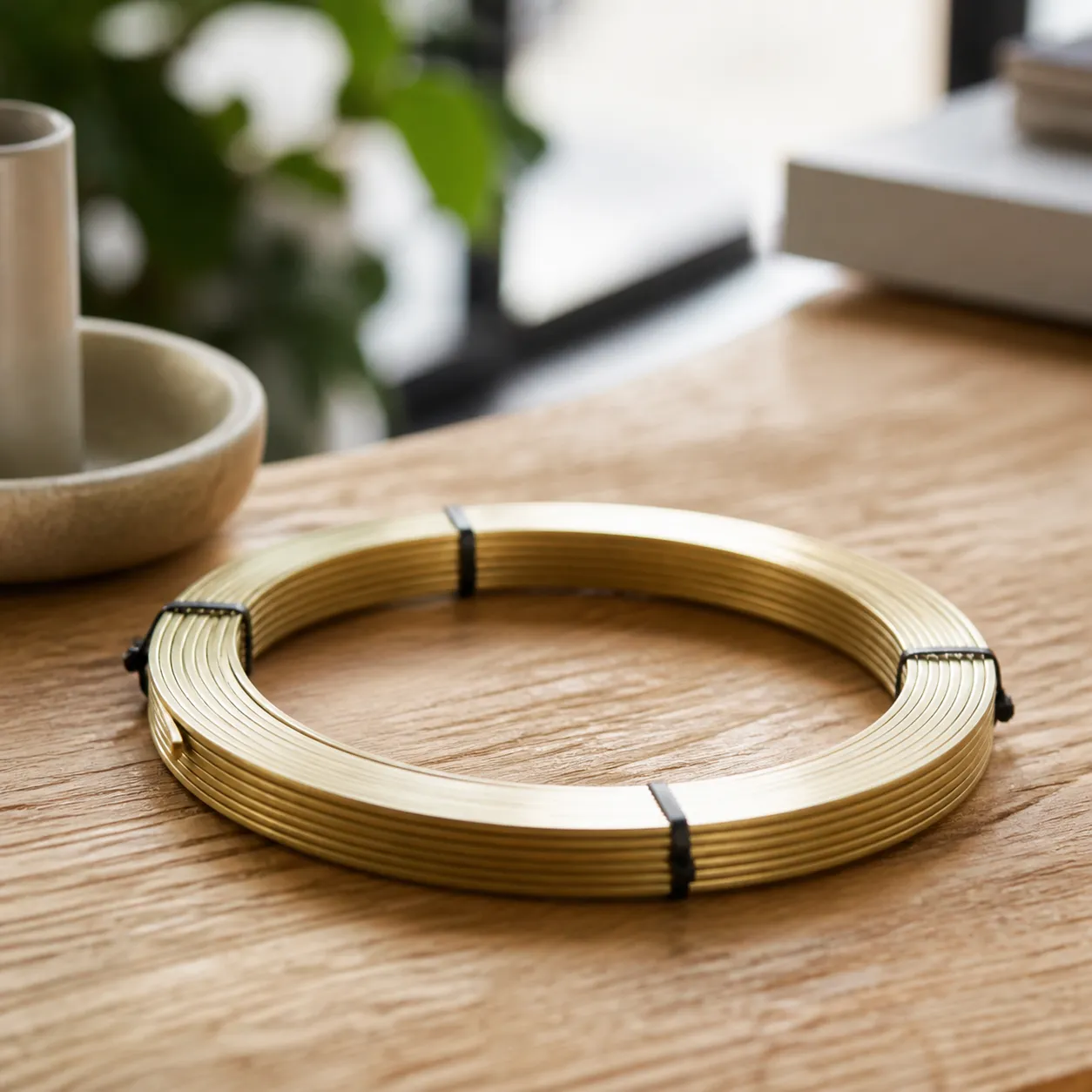
Flat brass wire combines a defined flat section with the properties of a copper-zinc alloy. It is considered for formed hardware, decorative parts and electrical components where appearance, mechanical performance and conductivity need to work together.
The useful choice is a complete material specification: alloy, supplied condition, section and surface. This guide explains how those choices affect manufacture and service. For comparison across different metals, start with our flat wire material selection guide.
Manufacturing Process: Rolling, Drawing and Material Condition
Rolling and drawing establish the section and can increase strength through cold work. Annealing can soften work-hardened brass and restore capacity for further forming. Two pieces with the same alloy designation and dimensions can therefore behave differently if their supplied conditions differ.
For common binary brasses, strength is developed through composition and cold working rather than the quench-hardening route used for suitable carbon steels. The condition needed for a demanding bend may differ from the condition needed by a finished retaining component.
Corrosion Resistance and Appearance
Brass can gradually tarnish in atmospheric exposure. A change in surface appearance is not the same as every form of corrosion damage. Where the initial yellow finish matters, appearance retention is part of the surface requirement.
In conditions that cause dezincification, zinc is selectively removed, leaving a copper-rich surface or weakened region. Stress corrosion cracking is a different mechanism, involving tensile stress and a susceptible environment, such as moist ammonia. Select for the actual moisture, cleaning chemicals and stress conditions rather than treating copper content alone as a durability rating.
Electrical Conductivity
Adding zinc gives brass a different balance of strength, forming behaviour and conductivity from pure copper. For a connector or terminal, brass may offer useful mechanical properties, while copper is a starting point when very high conductivity is the main requirement.
Compare the specified alloy and condition, not just the word “brass.” The conductor’s section and the design of the connection also matter. Our copper flat wire guide explains the electrical, temper and surface considerations for copper.
Section, Edges and Surface Quality
A rectangular section defines the broad face and thickness direction, but it does not fully describe the corners or edges. An edge that passes through a guide may have a different requirement from one that becomes visible after stamping.
Keep appearance and shape checks separate. A polished face does not establish a burr limit, straightness or dimensional accuracy. Use our flat wire cross-section and inspection guide for those drawing details.
Formability and Machinability
Softened brass generally offers more capacity for further deformation than a heavily cold-worked condition of the same alloy. Harder material can offer higher strength, but the remaining forming demand still matters at bends and stamped features.
Cold-forming performance and machinability are separate selection questions. A brass chosen for deep drawing is not automatically the best choice for extensive cutting. Choose around the operation that creates the component, then check the properties required after manufacture.
Choosing a Brass Alloy and Supplied Condition
H65 and H70 identify different brass compositions. Their names are useful starting points, but neither defines a complete flat-wire specification or a guaranteed forming result.
H65: Evaluate the Forming and Mechanical Balance
H65 is a copper-zinc brass with nominal copper content around 65%. For hardware or formed parts, compare its mechanical properties in the intended supplied condition with the deformation needed to make the component.
A bend that cracks in a hard condition does not by itself show that the alloy is unsuitable. The starting condition, edge and forming detail also belong in the assessment. Equally, successful forming does not establish that the part meets its final load requirement.
H70: Consider the Higher-Copper Composition
H70 has nominal copper content around 70%. Brasses around the 70/30 copper-zinc composition are known for excellent cold formability, making this composition worth considering for demanding formed features.
That forming potential still depends on condition and geometry. When comparing H70 with H65, compare the mechanical limits and forming result in the intended conditions. Higher copper content alone does not establish a universally better component or a guaranteed corrosion result.
Match the Designation to the Material Specification
Use the full alloy designation and applicable material specification for an existing design. Similar nominal copper contents are not sufficient to establish that different national designations are interchangeable.
- For a formed component: compare alloy and condition against the most demanding feature.
- For a current-carrying component: use conductivity or resistance data for the selected material.
- For a visible part: assess the actual surface after forming and any later finishing.
Applications of Flat Brass Wire
Precision Hardware and Fasteners
For a folded fastening part, the starting material must permit the bend while the finished part resists unwanted permanent deformation. Compare those two stages separately. For visible hardware, include the bend and cut edge in sample approval rather than judging only an unformed polished length.
Electrical and Electronic Components
A terminal can need both electrical conduction and mechanical retention. Balance the current path with forming and holding requirements. A grade’s general electrical use does not establish the allowable current or contact performance of a particular design.
For a contact that remains deflected during use, evaluate the retained force under the operating conditions. Hardness at delivery alone does not establish long-term contact behaviour.
Zipper and Clothing Accessories
Distinguish an ordinary flat section used for further component manufacture from a dedicated tooth or stop-wire profile. The finished zipper size does not define every dimension of the raw-material cross-section.
For metal zipper teeth, the Y-teeth wire product page provides the dedicated profile enquiry route. Material, finish and tooling requirements belong with that profile, rather than being inferred from a generic brass flat-wire description.
Frequently Asked Questions
Is H70 Always a Better Choice than H65?
No. Higher copper content is one compositional difference. The useful comparison includes the required mechanical properties, forming operation, electrical function, surface and service environment.
Does Full-Hard Brass Automatically Suit a Spring Component?
Full-hard describes a supplied condition, not an approved spring design. The material must tolerate any remaining forming and meet the finished component’s load, movement and retained-force requirements.
Is Brass-Coloured Composite Wire the Same as Solid Brass?
No. Solid brass is a copper-zinc alloy through its section. A clad composite has distinct surface and core materials, so forming and electrical performance must be assessed for that construction. Similar colour does not establish material equivalence.
What Information Helps with a Material Selection Enquiry?
Include the alloy if already specified, width, thickness, condition and quantity. Add the component drawing and the requirement that drives selection, such as a critical bend, electrical function or visible finish. Identify the required product form as well as the material.
For help discussing a material requirement, send Fullgreat your application and drawing. Include the exact alloy and supply form if specified, together with the operations that follow delivery and the finished component’s key requirements.