Blog
Electrical Steel Coil Guide: CRGO vs CRNGO

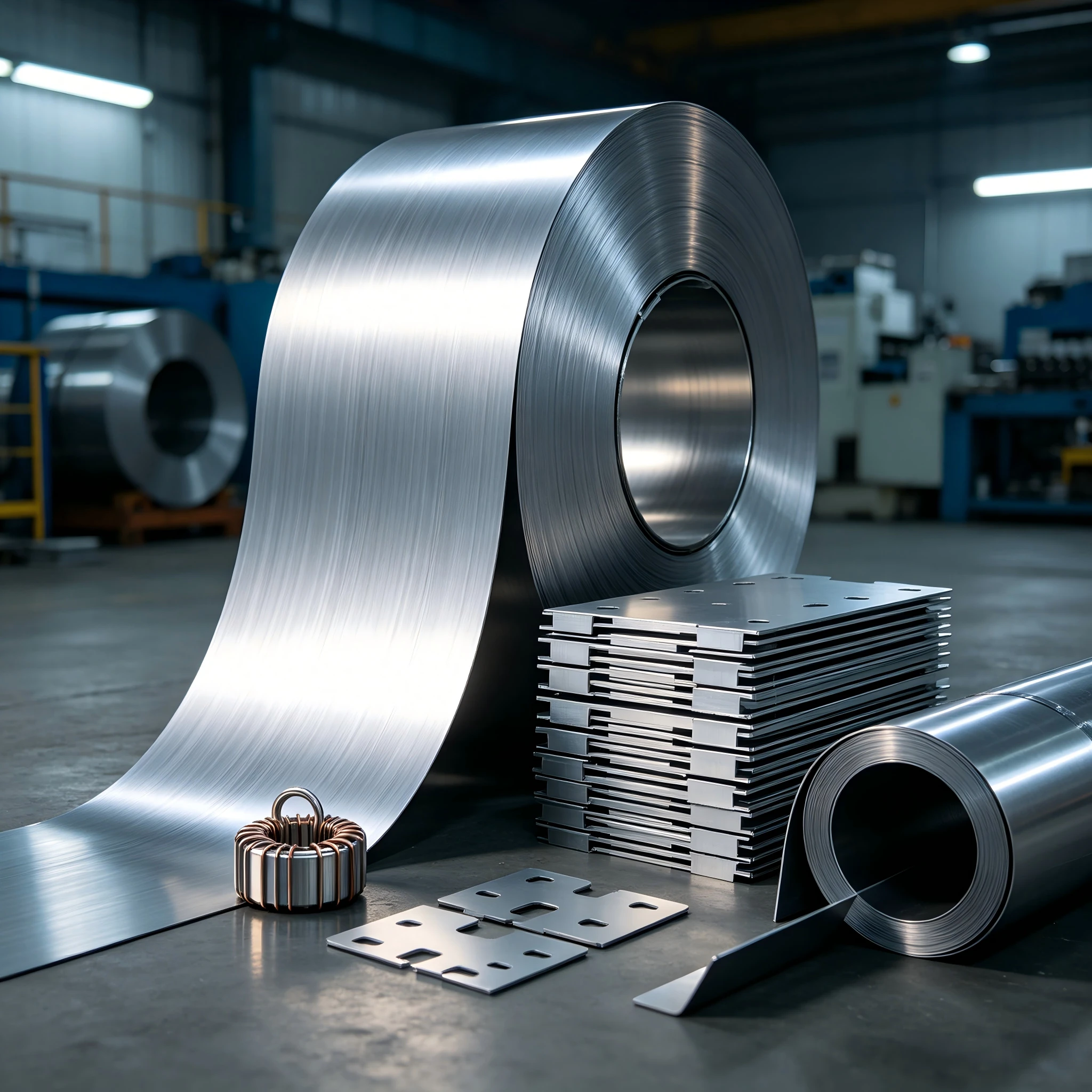
An electrical steel coil is the quiet engine inside every transformer, motor and generator you have ever used. It is the grain of the steel — oriented or not — that decides whether a motor runs at 93% or 97% efficiency, and whether a transformer core hums with wasted heat. If you source electrical steel coil for electric motors, transformers, EV traction motors or power electronics, this guide walks through the two families (CRGO and CRNGO), the specs that actually matter, and how to buy it from a supplier that verifies what they ship.
What Is Electrical Steel (Silicon Steel)?
Electrical steel — also called silicon steel — is a specialty steel alloyed with 1% to 4.5% silicon, designed to minimise energy loss in magnetic circuits. The silicon does two jobs: it raises electrical resistivity (cutting eddy-current losses) and it stabilises the magnetic properties of the steel. Without it, transformer and motor cores would overheat and waste unacceptable amounts of energy.
It is sold as electrical steel coil (wound strip), then slit and punched into laminations that are stacked to build transformer cores, motor stators and generator rotors.
CRGO vs CRNGO: The Two Families
The single most important decision when sourcing electrical steel coil is which family you need. The difference is crystal orientation.
| Property | CRGO (Grain-Oriented) | CRNGO (Non-Grain-Oriented) |
|---|---|---|
| Grain structure | Grains oriented in the rolling direction — magnetic flux follows the grain | Grains randomly oriented — magnetic properties similar in all directions |
| Best magnetic path | Single direction only | All directions |
| Iron loss | Very low along rolling direction | Low but uniform in every direction |
| Typical use | Transformers, power cores, high-efficiency stators | Motors, generators, small transformers, rotating machines |
| Thickness range | Typically 0.23–0.35 mm | Typically 0.35–0.65 mm |
| Cost | Higher | Lower |
Rule of thumb: if the magnetic flux travels in one direction (transformer core), choose CRGO. If it rotates (motor stator, generator), choose CRNGO — because the field changes direction and needs uniform permeability in all directions.
The Specs That Actually Matter
When you evaluate an electrical steel coil, four numbers decide whether it is right for your application:
- Iron loss (core loss) — energy wasted as heat per kilogram, usually specified in W/kg at 1.5T/50Hz (or 1.7T). Lower is better; this is the number that defines the grade.
- Magnetic induction (flux density) — how much magnetic flux the steel can carry, in tesla (T) at a given field strength (e.g. 1.5T or 1.7T). Higher is better.
- Thickness — thinner strip lowers eddy-current loss but costs more to roll. Grade and thickness are bought together.
- Insulation coating — an inorganic/organic coating on the surface that prevents eddy currents between stacked laminations. Specify the coating class your lamination process needs.
These are governed by international standards — typically IEC 60404 and ASTM A677 (for CRNGO) / ASTM A876 (for CRGO) — plus national standards like JIS C 2552. The electrical steel coil we supply is produced to IEC 60404 / ASTM A677, with full Mill Test Certificates. For what to check on the certificate, see our MTC / EN 10204 3.1 explainer.
Applications at a Glance
| Application | Recommended family | Why |
|---|---|---|
| Power / distribution transformers | CRGO | Unidirectional flux, low iron loss is critical |
| Electric motors & pumps | CRNGO | Rotating field, needs uniform properties |
| EV traction motors | High-grade CRNGO (or thin CRGO) | Efficiency at high frequency, low loss |
| Generators / alternators | CRNGO | Rotating magnetic field |
| Small transformers & reactors | CRGO or CRNGO | Depends on size and loss target |
| Power electronics / inductors | Thin-gauge electrical steel | High-frequency operation needs low eddy loss |
How to Choose: A Quick Decision Path
- Confirm the flux path — one direction = CRGO; rotating = CRNGO.
- Set the loss target — your efficiency requirement decides the grade tier, not your budget.
- Match thickness to frequency — higher operating frequency wants thinner strip.
- Choose the coating — make sure it is compatible with your punching/annealing process.
- Specify the standard — put IEC 60404 / ASTM A677 (or the national equivalent) in your enquiry, plus the exact grade.
For the broader question of how stainless and silicon steels relate in your sourcing plan — and which grades stay non-magnetic — see our non-magnetic stainless steel guide.
Buying Electrical Steel Coil: Supplier Checklist
- Get the full specification in writing — grade, iron loss, induction, thickness tolerance, width, coating class.
- Demand a traceable Mill Test Certificate with heat number and tested magnetic properties — not just chemistry.
- Confirm slitting precision — burr-free edges matter because laminations are stamped at high speed.
- Check coil weight and packaging for your line — inner diameter, weight per coil, moisture protection.
- Ask for a pre-production sample — run one lamination stamping trial before committing to volume.
Who We Are and What We Can Supply
Fullgreat Metal is the Shenzhen branch of Hong Kong FGI Group, one of South China’s largest metal processing, sales and logistics centres. Since 2008 we have served more than 1,000 enterprises and exported to 20+ countries including the US, UK, India and Turkey.
We supply CRGO and CRNGO electrical steel coil and strip to IEC 60404 / ASTM A677, together with our full line of stainless steel, hot-dip aluminized and other specialty strip. With ISO 9001:2015, GRS and OEKO-TEX STANDARD 100 certifications, a monthly capacity of 50,000 tons, an inventory of 10,000 tons and partnerships with 100+ steel mills in Japan, Korea, Germany, Taiwan and China, every shipment carries a traceable Mill Test Certificate. Full product detail is on our electrical steel product page.
Frequently Asked Questions
Q: Is CRGO or CRNGO better for motors?
A: For most motors, CRNGO (non-grain-oriented) is correct because the rotating field needs uniform magnetic properties in all directions. CRGO is for unidirectional-flux applications like transformer cores. EV traction motors increasingly use high-grade thin CRNGO for efficiency.
Q: What does “electrical steel coil” cost per ton?
A: It depends heavily on grade, thickness and order volume — CRGO is more expensive than CRNGO, and thinner high-grade strip costs more. Request a quote with your exact grade, width and annual volume from the product page above; prices also follow raw material markets.
Q: Can I use electrical steel for non-magnetic applications?
A: No. Electrical steel is magnetic by design — its whole purpose is to conduct magnetic flux efficiently. If you need non-magnetic material for sensors, instruments or MRI environments, use austenitic non-magnetic stainless steel instead.
Q: What thickness should I choose?
A: Transformers typically use 0.23–0.35 mm CRGO; motors and generators 0.35–0.65 mm CRNGO. Higher operating frequency and tighter loss targets push you to thinner strip, which costs more per ton.
Need electrical steel coil for transformers or motors? Send your grade, iron-loss target and dimensions to Bruce@fullgreat.com — we will confirm availability, IEC 60404 / ASTM A677 compliance and MTC documentation before you commit.