Blog
Brass Look Furniture Hardware: A Copper Clad Stainless Steel Sourcing Guide

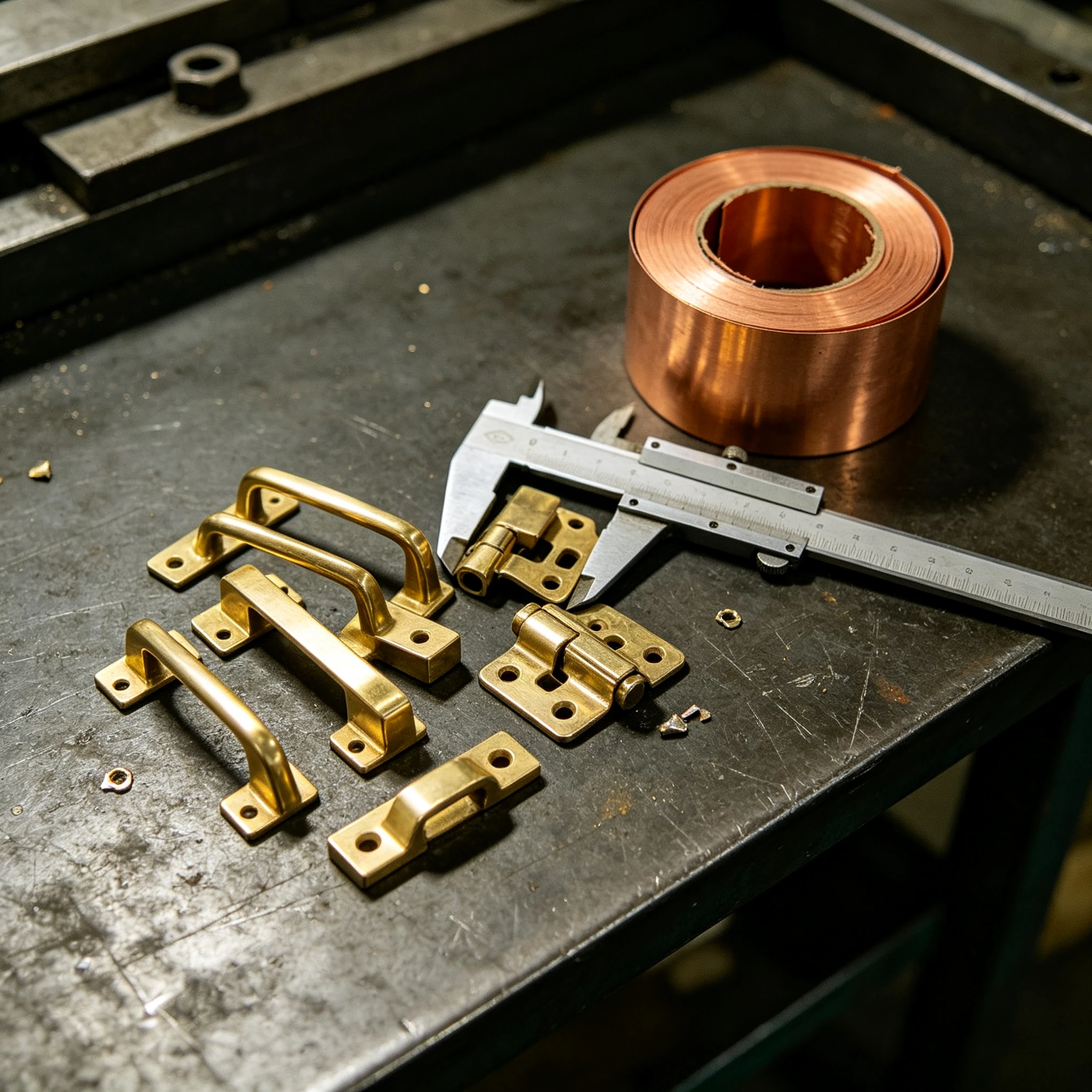
Brass Look Furniture Hardware: The Sourcing Guide Hardware Manufacturers Need in 2026
A hotel group in the Middle East just approved a 4,000-room fit-out. The interior specification calls for brass look furniture hardware on every wardrobe, bedside table and writing desk — brushed brass cabinet pulls, antique brass hinge plates, copper-tone decorative trim. The procurement director does the arithmetic and finds that specifying solid brass for 4,000 rooms will consume the entire hardware budget before a single lock is installed.
That scene repeats every week in furniture factories, interior fit-out companies and hardware trading houses across the world. The demand for brass look furniture hardware has never been stronger, but the economics of solid brass have never been harder to justify at volume. This guide explains how leading hardware manufacturers are solving the problem with copper clad stainless steel — a material that delivers the brass appearance buyers want, the stamping and forming performance production lines need, and a material cost roughly 40–50% of solid brass.
Why “Brass Look” Demand Is Not the Same as a Brass Purchase Order
Before choosing a material, it is worth separating what buyers actually mean when they specify brass look furniture hardware. In nearly every project, the specification is driven by four requirements, and only one of them is metallurgical:
- Appearance — the warm golden tone, the brushed or antique surface, the way the hardware catches the light. This is what interior designers actually approve.
- Perceived quality — the weight in the hand, the solid feel of a well-made pull or hinge, the absence of thin plating that flakes.
- Durability — resistance to tarnishing, scratching, corrosion in humid coastal or hotel environments, and wear in high-touch applications.
- Cost — the budget reality of specifying hardware across hundreds or thousands of units.
Solid brass satisfies all four, but at a price that is increasingly difficult to defend. Brass-plated steel satisfies cost but fails on durability and perceived quality within a few years. The material that satisfies all four — including a genuine copper surface rather than a thin plating — is copper clad stainless steel. That is why brass look furniture hardware is quietly becoming one of the fastest-growing applications for clad metal strip in Asia.
Why Brass Look Furniture Hardware Is a Growth Category in 2026
Brass look furniture hardware is not a niche styling choice — it has become one of the most specified finish families in commercial and residential interiors. Three demand drivers are pushing the category forward at the same time.
- Hospitality and contract fit-out — hotels, serviced apartments and resort developments are the single largest consumers of brass look furniture hardware. A single mid-sized hotel tower specifies thousands of pulls, hinges and trim pieces, and design teams consistently choose warm metal finishes because they read as premium in photographs and hold up across different room styles.
- Residential renovation cycles — the current interior cycle favors brushed brass, antique brass and polished copper accents in kitchens, wardrobes and built-in cabinetry. Hardware is one of the cheapest elements of a renovation to upgrade, so it turns over frequently — which means recurring demand for manufacturers who can supply the finish reliably.
- E-commerce and export brands — online furniture and hardware brands need consistent SKU-level quality at scale. A brand selling cabinet pulls across multiple markets cannot tolerate the batch-to-batch variation of cheap zinc die-cast parts, which pushes procurement teams toward materials with controlled mechanical properties and documented quality.
Each of these buyers is a volume buyer, and volume is exactly where the cost gap between solid brass and copper clad stainless steel becomes decisive. The design intent stays the same; the material underneath changes.
The Material Decision Map: Four Ways to Make Brass Look Hardware
Hardware manufacturers have four practical routes to a brass appearance. Each has a place; the right choice depends on the product, the volume, and the end market.
| Route | Appearance | Durability | Cost | Best fit |
|---|---|---|---|---|
| Solid brass (C2680, C2600) | True brass, ages naturally | Excellent; tarnishes but polishes | Highest; copper price exposure | Luxury bespoke hardware, low volume |
| Copper clad stainless steel (FPD726) | True copper surface; brass/gold/antique via surface treatment | Excellent; stainless core resists denting and fatigue | 40–50% of solid brass | Volume hardware, hospitality, contract projects |
| Stainless steel with brass electroplating | Brass color initially | Plating can wear or flake on edges | Moderate | Short-lifecycle products, low wear |
| Zinc alloy die-cast with brass finish | Good at a distance | Weak under load; coating-dependent | Low | Decorative knobs, non-structural parts |
The key insight: for brass look furniture hardware that must survive daily use, support real loads, and keep its appearance for years, the two serious candidates are solid brass and copper clad stainless steel. The decision between them is almost entirely cost per unit — and at contract volumes, that difference is decisive. For a full technical comparison of the clad material against pure copper, see our copper clad stainless steel vs pure copper guide.
What Copper Clad Stainless Steel Actually Is
Copper clad stainless steel — supplied by Fullgreat as FPD726 — is a three-layer composite: a copper outer layer on both faces, bonded metallurgically to a non-magnetic stainless steel core. The material is produced as precision strip and wire, then stamped, formed or machined into hardware components. From the outside, a finished pull or hinge is indistinguishable from a solid copper or brass part; from the production side, it behaves like a high-strength metal strip with a copper surface.
The structure matters for furniture hardware in three ways. First, the copper layer is genuine copper — not a plating a few microns thick — so the surface can be brushed, polished, aged, lacquered or electroplated exactly like solid brass, and it will not peel or flake at sheared edges. Second, the stainless core carries the load: it resists the bending, denting and fatigue that thin-plated parts suffer, so hardware keeps its shape over years of use. Third, because the core is only a fraction of the material volume, the copper content — and therefore the material cost — drops to roughly 40–50% of a solid copper or brass part. The economics of this structure are explained in detail in our copper clad non-magnetic stainless steel guide.
Production Line Reality: Stamping, Forming and Finishing
A material only earns its place on a hardware line if it performs through every step of production. Copper clad stainless steel has been proven across the operations that brass look furniture hardware actually goes through:
- Stamping and blanking — the strip runs through progressive dies at production speeds comparable to brass. The stainless core holds tighter dimensional tolerance than softer zinc alloys, reducing burr and die wear over long runs.
- Bending and forming — handles, brackets and hinge plates need clean, crack-free bends. FPD726 is supplied in controlled tempers, from annealed for deep forming to hard-rolled where spring-back resistance is needed, so the formability is matched to the part geometry.
- Sheared edge quality — the copper layer is metallurgically bonded, so sheared edges show clean copper rather than a peeling plating line. Edge condition can be specified milled or deburred for visible edges.
- Surface finishing — because the surface is solid copper, it accepts brushing, satin finishing, mirror polishing, antique aging, lacquering, and electroplating in brass, gold, gunmetal or champagne tones. This is what makes one material family able to cover the entire brass look furniture hardware palette.
- Fastening and assembly — tapping, riveting and screw insertion all behave consistently, without the brittle failure of cast zinc or the softness of thin-plated steel.
Two production details deserve special attention from tooling engineers. First, die wear: the stainless core is harder than brass or zinc, which extends progressive-die life but also means tool steel selection and lubrication matter more than with softer alloys. Manufacturers who run the clad material usually report that the reduced burr formation — a direct result of the tighter tolerance and cleaner shear — offsets the slightly higher demands on tooling. Second, spring-back: in hard-rolled tempers the strip resists bending more than annealed brass, so bend radii and coining pressures must be verified in the trial run. Neither issue is a barrier; both are simply parameters that should be confirmed on a sample coil before volume commitment, and both are covered by the trial protocol we recommend at the end of this guide.
For hardware manufacturers running mixed product lines, this production compatibility is the difference between a material that is trialled and a material that is adopted. The same strip also feeds related decorative hardware applications — see our composite copper strip product page for available sizes and tempers, and the composite copper wire product page for wire, flat wire and Y-profile formats.
Which Hardware Components Convert Best
Not every brass look furniture hardware component benefits equally from the clad material. Based on production experience, here is how different component families convert:
| Component | Conversion to FPD726 | Reason |
|---|---|---|
| Cabinet and drawer pulls | Excellent | Stamped or formed, high volume, appearance-critical, low corrosion demand indoors |
| Hinge plates and brackets | Excellent | Load-bearing; the stainless core adds dent and fatigue resistance |
| Decorative trim and edging | Excellent | Strip-fed, long lengths, finish-driven; copper surface takes brushing and aging |
| Furniture feet and ferrule caps | Good | Formed from strip or wire; strength benefit in thin sections |
| Lock escutcheons and panels | Good | Stamped plates; consistent surface for electroplating and engraving |
| Solid-cast decorative knobs | Less suitable | Cast geometries are not strip-fed; zinc die-cast or solid brass remains the route |
The pattern is clear: the material wins wherever a component is stamped, formed or rolled from strip or wire — which is the majority of volume hardware in the furniture industry. Cast or turned one-off parts stay with traditional materials. This is why a hardware factory’s material strategy usually shifts progressively: the first trial is a flat stamped part, and the conversion spreads to formed and wire components as production confidence grows.
Covering the Full Finish Palette: Brass, Copper, Gold, Antique
One of the strongest arguments for copper clad stainless steel is that a single base material covers the entire warm-metal finish family used in furniture hardware. Interior specifications rarely stop at one finish — a project may call for brushed brass on wardrobe pulls, antique bronze on hinge plates, and polished copper on decorative trim.
- Brushed brass look — brush the copper surface with a fine abrasive belt, then apply a clear lacquer or a thin brass-toned electroplate. The result matches brushed solid brass in tone and texture.
- Antique / aged brass look — chemically darken the surface (liver of sulfur or proprietary aging solutions), then highlight the raised areas. This produces the deep, mottled antique look popular in classical and transitional interiors.
- Polished copper look — mirror-polish the copper layer and lacquer it. For interior design trends that specify exposed copper, this is a direct match.
- Gold / champagne tone — electroplate the copper surface in gold, rose gold or champagne shades, taking advantage of the copper layer’s excellent plating adhesion.
- PVD finishes — for high-wear applications such as door handles in commercial buildings, PVD coatings over the copper layer add abrasion and corrosion resistance while preserving the metallic depth of the look.
Because the surface is solid copper rather than a plating, these finishes behave predictably and last. The same finishing processes, the same chemicals, the same suppliers — hardware factories can convert to the clad material without changing their finishing department at all.
The Non-Magnetic Advantage Nobody Expects
Most hardware buyers never think about magnetism in furniture fittings. But the non-magnetic stainless core of FPD726 quietly solves problems that appear in specific environments:
- Needle-detection plants — garment and mattress factories that run 8-level needle inspection equipment require every metal component in the production environment to be non-magnetic, including the furniture and fixtures in the sewing and inspection areas. See our needle detection sourcing guide for the full requirement set.
- Medical and electronics facilities — furniture hardware in MRI-adjacent rooms, clean rooms, and electronics assembly lines must not interfere with sensitive instruments or be attracted by magnetic fixtures.
- Security and detection environments — airport furniture, courthouse fittings and other security-sensitive sites prefer non-magnetic hardware to avoid false alarms and interference.
- Quality perception — the non-magnetic property is also a simple field test a buyer can do with a magnet, which some specifiers use as a quick check of material quality.
This is a genuine differentiator that solid brass cannot claim (brass itself is non-magnetic, but brass-plated steel is not) and that zinc alloys cannot claim either. If your brass look furniture hardware is destined for any regulated or sensitive environment, the clad material removes an entire class of specification risk.
Specifying the Material: What to Put on the Purchase Order
When you move brass look furniture hardware production onto copper clad stainless steel, specify these parameters on the enquiry to avoid surprises downstream:
- Grade and structure — FPD726 (copper / non-magnetic stainless steel / copper three-layer). Confirm the core grade if you need specific mechanical properties.
- Thickness and tolerance — specify the finished strip thickness and the tolerance band you can accept; precision slitting holds cross-section tolerance to ±0.01 mm where required.
- Width and coil form — specify slit width, coil weight and inner diameter to match your die and feeder.
- Temper — annealed for deep forming, hard-rolled where stiffness is required; confirm the hardness range in HRV or HV.
- Edge condition — milled, deburred or rounded edges for visible parts and high-speed stamping.
- Surface — bright or matt copper surface, and whether you will finish in-house or require pre-finished material.
- Documentation — require a Mill Test Certificate with heat number confirming chemistry, bond integrity and hardness. Our MTC / EN 10204 3.1 explainer lists what to check.
The Cost Logic in Plain Terms
No two projects have the same cost structure, so we will not quote figures here — the arithmetic depends on volumes, widths, tempers and finishes. But the logic is simple and consistent. In a solid brass pull, the entire cross-section is expensive copper-zinc alloy. In a copper clad stainless steel pull, only the visible surface is copper; the core — half or more of the material volume — is stainless steel, which costs a fraction of copper. The copper content of the part falls to roughly 40–50% of a solid copper or brass part, and the cost follows the copper content.
The saving compounds with volume. At a few hundred pieces, the difference is immaterial. At tens of thousands of pulls, hinges or trim sections, the annual material saving is the difference between a profitable contract and a loss-making one — which is exactly why contract furniture suppliers, hotel fit-out contractors and OEM hardware brands have been converting specifications. It is also why the clad material protects you against copper price volatility: your exposure to copper price swings is roughly halved.
To build the business case internally, model three numbers before you approach suppliers: the copper content of your current part, the copper content of the clad equivalent, and your annual volume. The first two determine the saving per part; the third turns it into an annual figure. Even at a modest per-part saving, a hardware line running millions of parts per year converts that saving into a meaningful line item on the annual budget — which is why the conversion decision is usually made at the purchasing and finance level, not by the design team alone. Design specifies the finish; procurement chooses the material that delivers it economically.
Quality Control and Supply Assurance
Consistency is the hidden cost driver in hardware manufacturing. Material that varies in hardness, thickness or surface quality between batches creates scrap, die adjustment and rework. Copper clad stainless steel from a bonded composite line is produced to controlled strip tolerances, and the key properties — bond integrity, thickness, hardness, surface — are documented per batch. Before committing volume, run a stamping trial on a sample coil: form a representative part, inspect sheared edges, bends and finish, and confirm the results against your existing production standard. A single trial coil is the cheapest insurance in the entire sourcing process.
Brass Look Hardware, Factory Direct
Fullgreat Metal is the Shenzhen branch of Hong Kong FGI Group, one of South China’s largest metal processing, sales and logistics centres. Since 2008 we have served more than 1,000 enterprises and exported to 20+ countries including the US, UK, India and Turkey.
We supply FPD726 copper clad stainless steel strip and wire for brass look furniture hardware — zipper and button accessories, furniture hardware, kitchenware, automotive interiors, electronic components, connectors and conductive parts — with precision slitting, custom widths, controlled tempers, deburred edges and traceable Mill Test Certificates. With ISO 9001:2015, GRS and OEKO-TEX STANDARD 100 certifications, a monthly capacity of 50,000 tons, an inventory of 10,000 tons and partnerships with 100+ steel mills in Japan, Korea, Germany, Taiwan and China, we hold consistent grade and quality across repeat orders. If your project is still weighing solid brass against the clad alternative, see our C2680 brass strip guide for the solid-brass option, then compare.
Frequently Asked Questions
Q: Is brass look furniture hardware made from copper clad stainless steel really indistinguishable from solid brass?
A: In appearance, yes — the visible surface is genuine copper, so brushing, polishing, aging and plating produce the same results as on solid brass. In feel, a well-made part is comparable; the stainless core actually gives the part better resistance to denting. The difference is material cost, which drops to roughly 40–50% of solid brass.
Q: Does the copper layer wear off like brass plating?
A: No. Plating is a thin deposit measured in microns, and it can peel at edges or wear through over time. The copper layer in FPD726 is a metallurgically bonded solid layer — sheared edges show clean copper, and the surface thickness is sufficient for repeated finishing operations. This is the core difference between clad metal and plated metal.
Q: Can we get the material in wire form for formed hardware?
A: Yes. FPD726 is available as strip, round wire, flat wire and custom-profile wire, including Y-profile for zipper teeth. If your hardware uses drawn or formed wire components, see the composite copper wire product page for formats.
Q: Is copper clad stainless steel suitable for outdoor or humid environments?
A: The copper surface will develop a natural patina over time, exactly as solid copper or brass does outdoors. For indoor furniture hardware, a clear lacquer or a PVD coating preserves the finish. The stainless core adds corrosion resistance where plating on steel would eventually rust through.
Q: What is the MOQ and lead time?
A: MOQ depends on width, thickness and temper — typically from a few hundred kilograms per grade. Lead time is quoted per order. Send your specification to Bruce@fullgreat.com and we will confirm availability, temper and MTC documentation.
Q: Can brass look furniture hardware made from FPD726 be engraved or embossed?
A: Yes. The copper surface layer is thick enough for fine engraving, and the stainless core holds crisp embossed detail without distortion. Luxury hardware brands use this for logos and pattern work on pulls and escutcheons — a capability that thin-plated parts cannot offer reliably.
Q: How do we compare a quote for FPD726 against our current C2680 brass strip price?
A: Compare on copper content and finished part cost rather than strip price alone. Request the FPD726 quote at your working thickness and width, calculate the part weight difference, and include scrap and die-life effects. Our team can provide a structured comparison against your existing C2680 specification — see our C2680 brass strip guide for the solid-brass baseline, then ask us for the clad alternative quote.
Ready to convert your brass look furniture hardware line to copper clad stainless steel? Send your part drawings, finish requirements and annual volumes to Bruce@fullgreat.com — we will recommend the strip or wire format, temper and edge condition, and confirm the cost position against your current solid brass specification.