Blog
316L Stainless Steel Strip: Low-Carbon Marine-Grade Specification & Sourcing

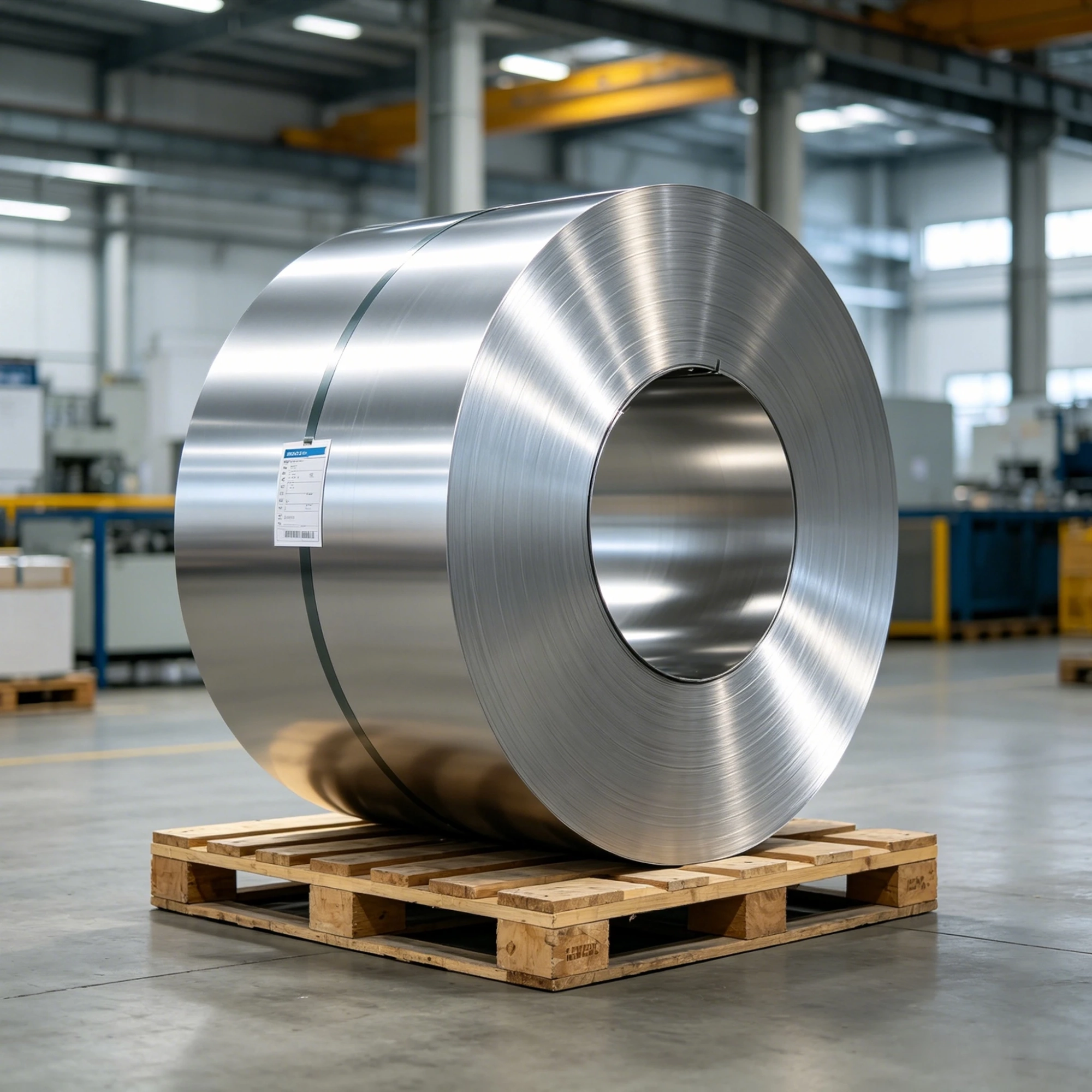
316L is the low-carbon variant of Type 316 austenitic stainless steel, the second most widely used stainless grade after 304. The “L” suffix designates low carbon, with a maximum carbon content of 0.030% — roughly half the upper limit of standard 316 (0.080%).
This reduced carbon content is not a minor specification detail. It directly determines whether the material survives welding and high-temperature fabrication without becoming susceptible to intergranular corrosion — a failure mode known as sensitization or weld decay. For strip products that undergo subsequent forming, welding, or brazing into final components, 316L is often the correct grade, not 316.
For the fundamentals of non-magnetic stainless steel behavior, see our Non-Magnetic Stainless Steel: The Definitive Guide and our grades comparison guide.
What Is 316L Stainless Steel?
316L belongs to the 18Cr–12Ni–2Mo family of austenitic stainless steels. The addition of 2.0–3.0% molybdenum is what separates 316/316L from 304. Molybdenum dramatically improves resistance to chloride-induced pitting and crevice corrosion, making 316L the default choice for marine, coastal, chemical-processing, and de-icing-salt environments where 304 would eventually pit through.
In stainless steel strip form — typically supplied in thicknesses from 0.05 mm to 3.0 mm and widths from 3 mm to 600 mm — 316L is used across a vast range of industrial components: stamped and deep-drawn parts, flexible metal hose, bellows, gaskets, shims, springs, watch cases, surgical instruments, food-processing equipment, and architectural trim. For sourcing guidance on precision strip, see our stainless steel strip supplier guide.
Chemical Composition (ASTM A240 / A666)
The table below lists the required chemical composition for 316L stainless steel strip per ASTM A240 and ASTM A666.
| Element | Symbol | 316L Limit (wt%) | 316 Limit (wt%) | Function |
|---|---|---|---|---|
| Carbon | C | ≤ 0.030 | ≤ 0.080 | Controls sensitization; low C = weld-safe |
| Silicon | Si | ≤ 1.00 | ≤ 1.00 | Deoxidizer; improves oxidation resistance |
| Manganese | Mn | ≤ 2.00 | ≤ 2.00 | Austenite stabilizer; improves hot workability |
| Phosphorus | P | ≤ 0.045 | ≤ 0.045 | Impurity; controlled for toughness |
| Sulfur | S | ≤ 0.030 | ≤ 0.030 | Impurity; low S improves weldability & surface |
| Chromium | Cr | 16.00 – 18.00 | 16.00 – 18.00 | Primary corrosion-resistance element |
| Nickel | Ni | 10.00 – 14.00 | 10.00 – 14.00 | Austenite stabilizer; improves toughness & ductility |
| Molybdenum | Mo | 2.00 – 3.00 | 2.00 – 3.00 | Resists chloride pitting & crevice corrosion |
| Iron | Fe | Balance | Balance | Matrix element |
Key sourcing note: When you receive a Mill Test Certificate (MTC) for 316L strip, verify that the reported carbon content is at or below 0.030%. Some mills produce a “316/316L dual-certified” grade that meets both specifications — this is acceptable and common, but the certificate must explicitly state both grade designations. A 316 certificate with 0.050% carbon is not 316L. For full MTC verification guidance, see our Mill Test Certificate sourcing guide.
Mechanical Properties
316L strip is supplied in several temper (hardness) conditions, achieved through controlled cold rolling reduction. The same chemical composition can produce dramatically different mechanical properties depending on the degree of cold work. For more on how cold rolling affects hardness, see our cold rolling reduction ratio guide.
Annealed (Soft / Solution-Treated) Condition
| Property | ASTM A240 Minimum | Typical Value | Test Method |
|---|---|---|---|
| Tensile Strength | ≥ 515 MPa (75 ksi) | 550 – 650 MPa | ASTM A370 |
| Yield Strength (0.2% offset) | ≥ 205 MPa (30 ksi) | 230 – 310 MPa | ASTM A370 |
| Elongation (in 50 mm) | ≥ 40% | 45 – 55% | ASTM A370 |
| Hardness | ≤ 217 HB / ≤ 95 HRB | 170 – 190 HB | ASTM E10 / E18 |
Cold-Worked Temper Conditions (ASTM A666)
| Temper | Tensile (MPa) | Yield (MPa) | Elongation (%) | Typical Hardness | Common Applications |
|---|---|---|---|---|---|
| Annealed (A) | ≥ 515 | ≥ 205 | ≥ 40 | ≤ 95 HRB | Deep drawing, forming, flexible hose |
| Quarter Hard (1/4H) | ≥ 655 | ≥ 345 | ≥ 25 | 90 – 100 HRB | Moderate forming, gaskets, shims |
| Half Hard (1/2H) | ≥ 780 | ≥ 450 | ≥ 18 | 25 – 35 HRC | Stamping, springs, clips |
| Three-Quarter Hard (3/4H) | ≥ 930 | ≥ 620 | ≥ 12 | 35 – 42 HRC | High-strength springs, retaining rings |
| Full Hard (FH) | ≥ 1035 | ≥ 760 | ≥ 8 | 40 – 45 HRC | Flat springs, washers, precision parts |
Sourcing note: Tighter thickness tolerances and higher hardness levels require more precise rolling control. Not every supplier can consistently hold ±0.005 mm thickness tolerance at full-hard temper. Always request sample strips in your specified temper before committing to a bulk order.
Physical Properties and Magnetic Behavior
| Property | Value | Notes |
|---|---|---|
| Density | 7.98 g/cm³ (0.288 lb/in³) | Slightly higher than 304 (7.93) due to Mo |
| Melting Range | 1375 – 1400 °C (2507 – 2552 °F) | — |
| Thermal Conductivity | 16.3 W/m·K at 100 °C | Lower than carbon steel; lower than aluminum |
| Specific Heat Capacity | 500 J/kg·K at 20 °C | — |
| Coefficient of Thermal Expansion | 16.0 × 10⁻⁶ /°C (20–100 °C) | Higher than carbon steel; account for in welded assemblies |
| Electrical Resistivity | 74 μΩ·cm at 20 °C | Higher than carbon steel; not for high-conductivity applications |
| Magnetic Permeability | ≤ 1.01 (annealed, essentially non-magnetic) | Cold working can induce slight magnetism; 316L is more resistant than 304 |
Design note: The thermal expansion coefficient of 316L is approximately 50% higher than that of carbon steel. When 316L strip is welded or bonded to carbon steel components — common in mixed-material assemblies — differential thermal expansion can induce significant stress at the joint over temperature cycles.
Corrosion Resistance
Pitting Resistance Equivalent Number (PREN)
PREN is a widely used empirical formula for ranking the pitting corrosion resistance of stainless steels: PREN = %Cr + 3.3 × %Mo + 16 × %N. For 316L with typical composition (Cr 17.0%, Mo 2.2%, N 0.05%): PREN ≈ 24 – 26.
| Grade | PREN |
|---|---|
| 304 | 18 – 20 |
| 316L | 24 – 26 |
| 2205 duplex | 34 – 38 |
| 254 SMO (super austenitic) | 42 – 44 |
A higher PREN generally indicates better resistance to chloride pitting. However, PREN is a ranking tool, not a guarantee — actual corrosion performance depends on surface finish, heat treatment, weld condition, and the specific environment.
316 vs 316L: When to Choose the Low-Carbon Grade
What Is Sensitization?
When austenitic stainless steel is heated into the 425–870 °C (800–1600 °F) temperature range — as happens during welding, stress relieving, or hot forming — chromium carbides (Cr₂₃C₆) precipitate at the grain boundaries. This depletes the chromium content in the zones adjacent to the grain boundaries below the ~12% threshold needed for passivity. The result: narrow, chromium-depleted bands that are vulnerable to intergranular corrosion. This is sensitization, and the resulting failure is called weld decay or intergranular attack (IGA).
How 316L Prevents Sensitization
By limiting carbon to ≤0.030%, 316L drastically reduces the amount of chromium carbide that can precipitate during welding or thermal exposure. This makes 316L essentially immune to sensitization in normal welding and fabrication practice — without requiring post-weld solution annealing.
Typical Applications
Marine & Offshore
316L is the standard marine-grade choice within approximately 1 km of the coastline and for salt-exposed infrastructure. Applications include boat hardware, marine fittings, and offshore instrumentation.
Chemical & Petrochemical
316L resists phosphoric acid and acetic acid better than 304, and is widely used in chemical processing equipment, heat exchangers, and storage components.
Food, Beverage & Pharmaceutical
316L is the industry standard for hygienic equipment in pharmaceutical and biotech CIP/SIP applications, as well as food-processing equipment exposed to hot or aggressive cleaners.
Automotive & Transportation
For automotive and appliance components, 316L strip provides corrosion resistance in salt-exposed environments. For more on stainless strip applications, see our 430 stainless steel strip guide for automotive and appliance uses.
Precision Engineering & Watchmaking
Watch cases, surgical instruments, and precision components use 316L strip for its combination of corrosion resistance, formability, and stable mechanical properties.
Frequently Asked Questions
Q: Is 316L stainless steel magnetic?
A: In the annealed condition, 316L is essentially non-magnetic with a magnetic permeability of ≤ 1.01. However, cold working (rolling, forming, drawing) can induce slight magnetism — though 316L is more resistant to this than 304. For applications requiring strictly controlled non-magnetic performance, specify dedicated non-magnetic grades. See our guide to why austenitic stainless steel can become magnetic for the mechanism.
Q: Can 316L strip be welded?
A: Yes. The low carbon content (≤0.030%) makes 316L essentially immune to sensitization during welding, so no post-weld solution annealing is normally required. This is the main reason to choose 316L over 316 for strip that will be welded, brazed, or soldered into final components.
Q: What is the difference between 316L and 316LVM?
A: 316LVM (vacuum melt) is a high-purity, vacuum-remelted version of 316L with tighter control of inclusions and chemistry. It’s typically used for medical implants and high-reliability applications where maximum cleanliness and consistency are required. Standard 316L is sufficient for most industrial strip applications.
Q: Can 316L be used in seawater?
A: 316L performs well in marine atmospheric and splash-zone conditions, but for continuous seawater immersion it may pit at elevated temperatures or low flow rates. For full immersion, consider duplex (2205) or super-austenitic (254 SMO, 904L) grades instead.
Q: How does 316L compare to 304 for cost?
A: 316L costs approximately 30-50% more than 304 due to the molybdenum content (2.0-3.0%). Use 316L where chloride exposure, marine environments, or welding into critical components justify the premium; 304 is adequate for many indoor and mild atmospheric applications. For a full comparison, see our non-magnetic stainless steel grades comparison.
Need 316L stainless steel strip? Contact Bruce@fullgreat.com with your grade, temper, thickness, and width requirements for a factory-direct quote with verified MTC documentation.